Spacer

Wednesday, October 8, 2014

When piety is not the motive . . . what is?


On September 27, 2014, the Aceh provincial parliament approved the Principles of the Islamic Bylaw and the Islamic criminal code (Qanun Jinayah), which create new discriminatory offenses that do not exist in the Indonesian national criminal code (Hukum Pidana). The bylaws extend Sharia, or Islamic law, to non-Muslims, which criminalize consensual same-sex sexual acts as well as all zina (sexual relations outside of marriage). The criminal code permits as punishment up to 100 lashes and up to 100 months in prison for consensual same-sex sex acts, while zina violations carry a penalty of 100 lashes. http://www.acehmail.com/2014/10/minorities-feel-threatened-with-indonesias-aceh-province-implementing-sharia/

I was searching for articles commenting on whether Joko Widodo, who assumes the presidency on October 20, is expected to do anything to rein in the Sharia law hysteria that now engulfs Aceh—and seems to be popular with no one except “the parliament,” whose members are rarely listed anywhere (Rami Sulaiman and Partai Aceh Spokesman Muhammas Harun being the exceptions). Interviews with Aceh citizens indicate that this “crackdown” does nothing but ruin business, restrict freedom of movement, and is a general pain in the ass to normal folks who just want to get on with some sort of semblance of normal daily life.

At the same time (September 28), the national parliament (controlled by the party of everyone’s favorite war criminal Prabowo Subiato and other supporting parties) passed a bill scrapping direct elections for provincial governorships, regency heads and city mayors.  Now, leaders will be chosen by “regional councils.”  This is certainly an anti-Jokowi measure, and aims to re-centralize the government, but I wonder if a) Aceh has to play along, being “autonomous” and all, and b) would a gubernatorial appointment be any different than current guv Zaini Abdullah, a big proponent of the pervert police—and why wouldn’t he be?  Prabowo’s Gerindra party made his life very easy both during and before the campaign.  They whipped up caliphate fervor all over the province, tapping into the desperation of thousands of ex-GAM combatants who hadn’t received a dime in promised compensation after the 2005 peace accord, and who watched GAM leaders assume positions of power and leave them in the dust.   “Jakarta has done you wrong,” was the message to the disaffected (read: nearly everyone) in Aceh.  “They don’t care about you, they’ll never help you, they don’t even want you to be a Muslim anymore!  Well they can’t take that away from you—down with Jakarta, up with Prabowo, and if you elect me I’ll let you stone and behead whoever you want.”
No one had ever really thought about stoning and beheading before, but now that he mentioned it, they really were good Muslims, and wanted to insulate themselves from a now-perceived “threat” in too-secular Jakarta, so the pervert police was born. And let the subjugation begin!
Prabowo and his greedy bunch really are very, very clever.
Add a substantial war chest, and poor little Aceh seems doomed.

So what’s Jokowi going to do about it?

Not much, if the Sept 22 article in the Nation, (“Jokowi’s Way”) mentioning Aceh only once, is any indication. Remember, he’s the guy who’s said he’s “pro economic expansion” and wants to increase palm oil production by 30%. “He is now backed by some of the most well-known oligarchs in the land, whose political parties are more like obliging banks . . . “ http://www.thenation.com/article/181466/jokowis-way 

Plus, Prabowo is not finished with Jokowi by a long shot.  See the Economist’s October 4 article, The Empire Strikes Back http://www.economist.com/news/asia/21621874-old-guard-out-obstruct-next-presidents-ambitious-plans-reforms-empire-strikes

The Sharia police have now extended their tentacles into rural Aceh, where you didn’t use to have to worry about hiring a driver who was not a husband or brother to take you somewhere, or receive agriculture training from a man who wasn’t a relative. 

"This bylaw has been highly anticipated by the people of Aceh, who have long wanted to see complete Islamic law on the veranda of Mecca," [Rami Sulaiman] said.” http://www.bangkokpost.com/lite/breakingnews/434576/aceh-approves-caning-for-gay-sex

In a pig’s eye they do.

You think the farmers in the Aceh Timur rainforest have time to worry about whether the boatman who takes them across the river to their cocoa farms is a relative?
You think tiny assistance providers like JMD are going to walk away from the livelihoods of 31 women and 500 family members?
I, however, will not be able to visit these programs.  I will not be able to be driven by the Director of the agency to see the projects that I have helped develop.  I’d laugh if it weren’t so pathetic and transparent.

“Ramli Sulaiman, chairman of an Aceh parliamentary commission that drafted the law, said proving extramarital and gay sex would be difficult.
‘There must be clear evidence and four witnesses who saw the act themselves,’ he said.
‘We can't just accuse people of having extramarital or homosexual sex.’"

And yet as far as I know, the 8 men who recently raped a woman as “punishment” for what they reported (but was never confirmed) as extramarital sex were never prosecuted, AND the raped woman was caned.

That possee of perverts lurking behind lampposts and popping out from behind padangs to arrest women with nail polish having coffee after sunset—are they just hoping for a quick feel before the trip to the police station?
Show me a practitioner of this horrid mangling of true faith and I’ll show you a sexually repressed loser with very few brain cells and an inability to think for himself.

Islam shmislam.  It’s sexual predation dressed up as holy order.  Shame on the lot of ‘em. 

This is, according to the Nation article,  “the result of what happens when you join Islamic modernism with dire economic prospects in a political system in which government elites are all too happy to exacerbate identity-based violence if it means avoiding discussions about their failure to do more for the country. Their sense of opportunism runs deep. Many of the sharia-type laws on the books in Indonesia have been introduced and passed by the secularist heirs of the Suharto government, eager to curry favor with radical Muslims and get on with business.”

So with both the provincial sharia bill and the national de-centralization bill, the national government, under the populist president, is going to be sanctioning sex-obsessed witch hunts in a country whose constitution forbids that Sharia law ever supersede or contradict the Constitution.

As Al Pacio would say, “I got nothin’.”

Tuesday, October 7, 2014

The cocoa harvest continues . . .


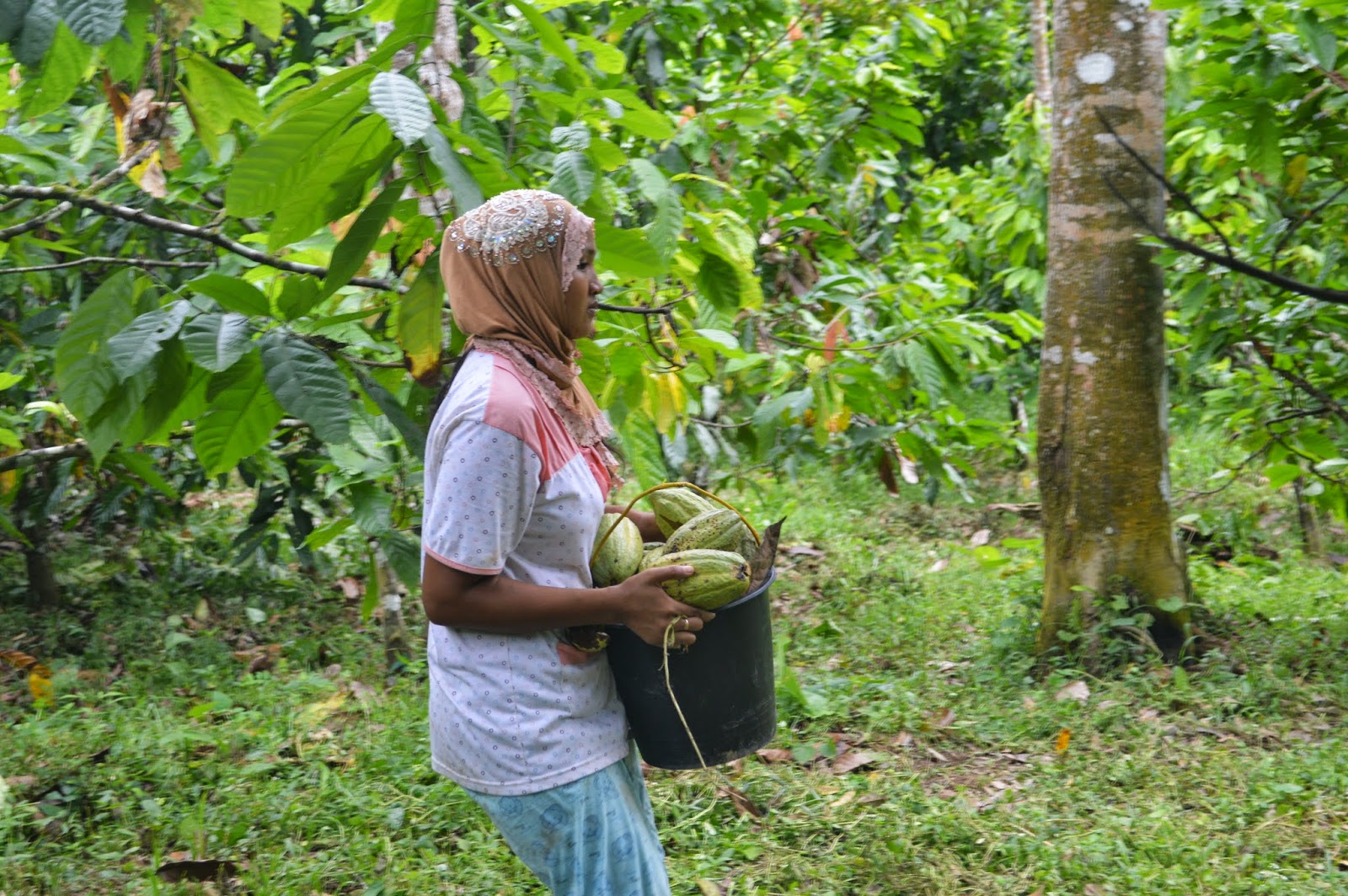
. . . and it’s a flurry of activity in Simpang Jernih and Pante Kera (two towns you don’t often see mentioned in print—and the world is the poorer for it). So let’s give the women (and their tiny helpers) a massive cheer for the incredible amount of work they have had to do this month. 


 Here’s Jamilah demonstrating good harvesting technique, and then bringing in some pods from her plantation.


Ibu Sauda is showing the interior of one of her pods. Very healthy looking!

Not only was the majority of the harvest coming in, there was lots of drying to do, PLUS the group is planting and cultivating 6,500 (count’ em) seedlings in their two nurseries. 

 Many have made it to their third week, but the immense rain during the last planting made life pretty miserable for about 1,000, so they will have to be replanted.
Leave it to Robert to save the day: the women are now using home-made “vermiculite” in the form of spent ash from their stoves to add to the medium to make it fluffier and coat the bean.  It seems to be working; nearly all of the seeds from Try #2 have sprouted.

 
Now that the farmers have 10 drying racks to share, the beans are looking better than ever—and fewer of them have to be culled.


Some farmers like to spread them out on a tarp first, to get rid of the bad beans.
Robert took these photos, and I love them all, but especially this one of a farmer’s husband looking over a big red tarp.


Here are two farmers drying and sorting their beans.


All is not rosy in Aceh Timur, however.
The women are now faced with the challenge of how to remove overgrown shade trees that cause the cocoa pods under them to rot.  The trees are too big to cut down with a machete now.  And some of them are valuable fruit trees that have to be replaced.
I am half thinking of marching myself into the forest and dragging out some illegal logging delinquent by his ear and having him make his chainsaw do some honest work for a change.

You know, I may be onto something . . .


Friday, October 3, 2014

Different face, same disregard for the rainforest


There was a bit of a kerfluffle this week in Jakarta, with news outlets commenting on the government’s elimination of “the controversial foreign ownership clause” in the new plantations bill.  Regardless of who controls palm oil plantations—foreign corporations or “smallholders” (and in this context the term is more than laughable)—Indonesia has recently “set an ambitious goal of raising its palm oil output by a third to 40 million tonnes by 2020.” (Reuters 10/1/14)  So where does the administration think that output is going to come from?  Doubtless new prez Jokowi is not only going to be referred to as being physically similar to our President, he can now be compared to Obama in terms of turning his back on all the environmental protection campaign promises he made prior to taking office.  
 
Tuesday’s Jakarta Post reported research analyst Hoe Lee Leng as saying “Widodo is known to be pro-business and pro-agriculture, so it [the foreign ownership clause] doesn’t sound like something he would implement once he comes into power.” Nice going. 

And I thought we had a chance with this guy.

If you ask me, the reason why this didn’t cause more of a ripple on the ground is that the bed is so crammed full of cross-national sleazeballs it doesn’t really matter in whose name the “ownership” of these palm oil disasters is listed. Nobody who’s currently making millions off the backs of the local communities and at the expense of the extinction of tigers, elephants, and orangutans is going to suffer.

Does Jokowi even realize this?  Does he have any environmental advisors?  Or he is just hoping we all look the other way and keep buying Hershey’s candy bars and Dunkin Donuts?

Tuesday, September 30, 2014

Global Exchange’s 2014 Most Wanted List Names HSBC Bank as #8 . . . and so well deserved!!!


CEO: Stuart Gulliver
Chairman: Douglas Flint
[both of whom I would dearly love to meet in a quiet, dark corner of the Aceh rainforest]

USA Headquarters:
452 5th Ave
New York, NY 10018
Phone: (212) 525-5000

Abuses: money laundering; financing conflict palm oil producers; destruction of land
HSBC is a leading global bank primarily involved in investment banking, originating from the United Kingdom and operating in over 85 countries. HSBC finances the production of palm oil as a financial backer and shareholder in companies like Sime Darby and Wilmar International.  [You remember Wilmar, the largest Palm oil company in Indonesia.] 

HSBC’s financial activity allows for land grabs and human rights violations in Malaysia, Indonesia, Liberia, and Uganda; in result these countries are facing severe land and environmental degradation including deforestation.
Production of conflict palm oil (an edible vegetable oil extracted from the pulp of palm fruit) is a world crisis causing extensive human rights violations and environmental degradation. HSBC’s financial assistance to palm oil producers like Wilmar is contributing to destruction of high conservation value land areas in Malaysia and Indonesia without approval of the local communities. People are being deprived of food and livelihood as they are forcibly evicted from the land where they have lived and worked for years.
HSBC is a signatory of the UN Global Compact, in which the bank agreed to principles surrounding human rights and environmental responsibility, yet it continues to violate human rights and degrade the environment. Additionally, HSBC has its own sustainability principles, but does not act on them, despite Willmar’s clear violations. Wilmar owns palm oil plantations and refineries in Indonesia, Malaysia, and Uganda. On Kalangala Island in Uganda, HSBC and Wilmar are responsible for the deforestation for 3,600 hectares, which has displaced farmers and families without compensation. Islanders are robbed of food, medicine, and livelihood. HSBC does not only loan money to Wilmar, but also has shares in the company.
Additionally, in 2012 HSBC was charged with cases of money laundering. In 2002 HSBC bought the Mexican bank Banco Internacional, S.A.; a review conducted before this purchase showed the bank did not have a functioning compliance program, but HSBC did not take preemptive action and tighten its anti-money laundering policies. According to the U.S. Senate's Permanent Subcommittee on Investigations’
2012 Report, HSBC is guilty of “a wide array of money laundering, drug trafficking, and terrorist financing.” Over the past decades, HSBC has funneled billions of dollars to drug lords, rogue nations, and even Saudi banks that are linked to terrorism. The Senate report says that HSBC had significant financial connections with Saudi Arabia's Al Rajhi Bank, and evidence indicates that the bank’s founder was “an early financial benefactor of al Qaeda.” Additionally, HSBC’s Mexican affiliate channeled $7 billion into the U.S. between 2007 and 2008 through money laundering for Mexican drug cartels, according to the Senate report.
Despite HSBC’s criminal behavior, the Senate deemed the bank “too big to prosecute.” The bank and the executives involved in the laundering decisions were granted immunity and still remain in leadership at the corporation. The only punishment for its crimes was a $1.9 billion fine, which is equal to about one month of HSBC’s profits. Although the corporation was fined for its criminal behavior, the executives were granted immunity from being individually prosecuted. With immunity granted to the executives, HSBC continues to prevail and put profits before people, even if it means engaging in criminal activity.

Does anyone besides me think that there is something terribly, terribly wrong here?  "Too big to prosecute?"  Immunity?  Have we all gone mad???
The LEAST they can do, as far as Aceh goes, is to sever ties with Wilmar.  Is that too much to ask? 

Aceh Province: Where “Conflict Palm Oil” really IS a product of conflict


Last summer, Rainforest Action Network, a tireless campaigner against palm oil and its myriad evils, launched a “Power is in Your Palm” campaign that singled out the top 20 companies who use palm oil.  RAN coined the term “conflict palm oil,” which has caught on quite well this past year, since when I was doing some side research the phrase appeared everywhere. I knew what “conflict palm oil” is in Aceh—but were there that many other places in the world where a 30-year armed insurgency has in effect protected the rainforest that now a peace accord and government complicity will destroy?


Not quite.


According to our friends at Mongabay, who always seem to get the scoop ahead of me, these 20 food giants (The “Snack Food 20”) are “failing to ensure the palm oil they source does not drive deforestation or worsen social conflict.”  http://news.mongabay.com/2013/0912-conflict-palm-oil.html#fBCQHSvVivUA7CXr.02

And FINALLY, as we suspected and reported here at length, “While many of these companies have pledged to source only palm oil certified under the Roundtable on Sustainable Palm Oil (RSPO) — the leading eco-standard — by 2015, the report argues that the RSPO doesn't do enough to protect forests or ensure "conflict-free" palm oil.”  That’s being kind—RPSO does NOTHING--as its members and policy-makers are—guess who?  the companies themselves.
 Charred tree stumps against the smoldering background in an area of recently deforested peatland near Tanjung Baru village, Pangkalan Kerinci subdistrict in Pelalawan regency, Riau province, Indonesia. The village lies beside PT. Pusaka Megah Bumi Nusantara (PMBN) – a palm oil company belonging to the Asian Agri group, a member of the Roundtable on Sustainable Palm Oil (RSPO).

Mongabay reports that “neither RAN, nor Greenpeace, which just published a report called Certifying Destruction: Why consumer companies need to go beyond the RSPO to stop forest destruction, are calling for companies to abandon the RSPO, which offers stronger environmental safeguards than the proposed Malaysian standard. [I can’t believe that’s possible.]  The groups instead are asking companies to establish policies that go beyond RSPO standards. And they are trying to rally consumers to do the same.”  http://www.greenpeace.org/international/certifying-destruction/

"The RSPO wants its members to be industry leaders in sustainability, but its current standards leave them free to destroy forests and drain peatland," said Bustar Maitar, head of Greenpeace International’s Indonesia forest campaign, in a statement. "Year after year, Indonesia’s forest fires and haze wreak havoc on the region, and the palm oil sector is a main culprit." 

Okay, so for RAN, “conflict palm oil” puts a nice, nasty, negative connotation on the product, which brings it into the public imagination like all good branding campaigns do. The “conflict” in palm oil is that this ubiquitous substance is found in roughly half the packaged products sold in US grocery stores, including favorite snack foods like ice cream, cookies, crackers, chocolate products, cereals, doughnuts and potato chips. “In fact, palm oil is likely present in some form in nearly every room of your home. It is being used as a replacement for controversial trans fats. And now Palm Oil production is one of the world’s leading causes of rainforest destruction. The clearing of rainforests and carbon-rich peatlands for new plantations is releasing globally significant carbon pollution, making Palm Oil a major driver of human induced climate change.Palm oil production is also responsible for human rights violations as corporations often forcefully remove Indigenous Peoples and rural communities from their lands. Tragically, child labor and modern day slavery still occur on plantations in both Indonesia and Malaysia.”
http://www.ran.org/join_the_palm_oil_action_team_now 

The removal of palm from 99% of all products would not harm anyone’s health, or negatively alter the product.  

However, it is one of the world’s largest commodities and makes a small number of people wildly wealthy and extremely powerful politically.

So there’s your conflict.

Now move to Aceh province, where a 30-year war that resulted in tens of thousands of deaths also decimated the fertile area on the buffer of the rainforest where generations of cocoa farmers had lived and worked.  The 2004 tsunami, which brought about the peace accord in 2005, meant two things:
--local communities could once again pick up where they left off—with assistance and training—and reclaim their plantations-turned-battlefields . . .
--the lack of armed GAM insurgents and Indonesian military brought out the jackals.  This area, which had been too dangerous to exploit previously, was now fair game to outside investors with bulldozes and government payoffs, and the only conflict these guys had was how many locals had to be thrown off a cliff or shot before the corporations were left alone to rip out the forest.

Now, that’s what I think of when I think of a conflict.
But I won’t begrudge RAN their campaign—if it works, I’m all for it.


The Snack Food 20 — Your Cookie, Indonesia’s Misfortune

Together these companies gross more than $432 billion in annual revenue. RAN believes they have the financial and brand clout to chain how palm oil is obtained, erase human rights violations and stop deforestation in Indonesian and Malaysia — if their consumers demand it.


  1. Campbell Soup Company
  2. ConAgra Foods, Inc.
  3. Dunkin’ Brands Group, Inc. (You know them as Dunkin Donuts)
  4. General Mills, Inc.
  5. Grupo Bimbo
  6. Hillshire Brands Company
  7. H.J. Heinz Company
  8. Hormel Foods Corporation
  9. Kellogg Company (think breakfast bars)
  10. Kraft Food Group, Inc.
  11. Krispy Kreme Doughnuts Corp. (more donuts)
  12. Mars Inc.
  13. Mondelez International, Inc.
  14. Nestlé S.A.
  15. Nissin Foods Holdings Co., Ltd.
  16. PepsiCo, Inc. (snack subsidiary, Frito-Lays)
  17. The Hershey Company (this makes two child labor problems for them, given their cocao sourcing issues)
  18. The J.M. Smucker Company
  19. Toyo Suisan Kaisha, Ltd.
  20. Unilever
So what’s a consumer to do? Read labels and if you see palm oil, skip buying the product. (It’s not that healthful anyway).
RAN would also like the public to send a message to these food companies to cut out the palm oil, and quit cutting down tropical forests.

Next: Global Exchange’s 2014 Most Wanted List Names HBSC as #8 . . . and so well deserved!!!

Friday, September 19, 2014

This harvest season, in a tiny corner of Indonesia's rainforest . . . women cocoa farmers are kicking butt!


Despite relative isolation, unimproved access roads, floods, drought, renegade monkeys, palm oil bulldozers and thugs threatening to muss them up, the women of Simpang Jernih subdistrict have launched into the new harvest season with a 35% increase in production and a 62% increase in price per beans.  How did they do it?  Organic fertilizer, good weeding and pruning, dedicated perimeter patrol, and lots of something they never had before: gentle and consistent encouragement from trusted and concerned agriculture extensionists.  Additionally, the women are now producing enough quantity simultaneously  that (thanks to their recent Marketing training) the buyer with whom they now deal directly has told them he will travel to them and pay the premium price for bulk cocoa every time they have over 30k (or about 80 pounds). At this rate that could be three times each harvest.


Field officer Robert reports that one farmer has now finally made enough money to pay for her daughter’s tuition at university in Kuala Simpang (the closest large city, also where the women are now selling their beans).  Isn’t that great??


As JMD Associate Director Junaidi wrote to me: 
“More trees, more production and more income = say NO to illegal logging!”

Who says the revolution does not begin at home?

Thursday, September 4, 2014

Back to Aceh Timur and those intrepid cocoa farmers


August was a busy month in Aceh Timur.  Because of some careful perimeter patrol and the application of homemade organic fertilizer/pest control, the women have experienced a 50% reduction in diseases and bugs on the plants, and much less monkey-munching.  The fertilizer keeps the cocoa flowers on longer, meaning more pods form.


Now THOSE are nice healthy cocoa pods!

The women were also hard at work planning about 6,500 cocoa seeds for their nursery.  Seedlings are used both to graft onto old growth trees to encourage more pods to form, and to create stronger “parents” to replace dead or dying trees.


And this month JMD sponsored the fifth Finnish Embassy-funded  training: Marketing.  This is a really new concept for the women, who have traditionally been at the mercy of local collectors or, when the collectors do not arrive in time, other vendors will barter goods for cocoa beans.  Now the women have developed a system to collect the harvest in one place and contact the actual buyer, who will pay a premium price for organically grown beans, and will travel from the port city of Kuala Simpang to pick it up, now that the quantity makes it worth his while.


There are a lot of other aspects to the marketing training that were covered, but we think that this was the most important: to let the women see that they have a desirable product and that if they play their cards right and unify their harvests, they can control the game and not the other way round.  This is an enormously large step for these women, many of whom have never been part of any group before, have difficulty reading and writing, and who now are initiating contacts with cocoa production companies, keeping records, and recording sales.  

Maybe a large NGO would think that unless an agency serves thousands of people at a time, a project isn’t “cost effective.”  I think that in this small community, the success of 31 women is a pretty big deal for everyone.