Spacer

Showing posts with label cocoa nursery. Show all posts

Tuesday, April 21, 2015

Update from Simpang Jernih

Junaidi just got back from doing some project monitoring in Simpang Jernih this week, and as far as I can tell he has nothing but good news to report.  Now that the rains have gone everyone’s applying fertilizer (they had to wait till a little later this year because of so much rain).  The project is now reporting a 65% organic fertilizer rate, which is pretty incredible.

Also, the rain held up a bit of the nursery grafting so the women got busy in their plantations and did 200 side grafts.  

Nursery work is hard and sometimes frustrating—all those little plants, so cute, so ready to drop dead at a moment’s notice—so the women in Pante Kera are taking extra care to replicate the good luck their colleagues in Simpang Jernih have had with a simple daily weeding schedule that keeps moisture down and doesn’t exhaust anyone.

And, of course, the cocoa trees are just beginning to flower so that means it’s monkey season (would you expect less from Pante Kera, which means, basically “the monkeys are on the riverbank”?) and farm families are now stepping up their perimeter patrols.
 This fellow might stay put in the forest if illegal logging didn't drive him farther towards the perimeter . . .

Actually, it’s Grand Central Station in the plantations this time of year, with wild pigs and loose goats nibbling at low branches (first lesson of Aceh propagation: graft higher than a goat’s head).  But Junaidi reports good things: the women are still motivated, thanks in large part to Robert, and they seem to be making lots more decisions independently.  Which is good for the sustainability of the project.  When it ends in 2016 they will hopefully have had enough of a taste of economic self-sufficiency to not only keep their business going but act as the “base” for what we hope will be other groups around the district that JMD can persuade to join the association.

Here’s hoping!


Wednesday, February 4, 2015

The sun has finally come out, and the women are back at work


In Aceh, this was a rainy season for the books.  Only yesterday did the river communities in Aceh Timur locate the transport raft and re-connect it to the iron cable that snapped during heavy flooding this season, leaving many without access to markets, healthcare, or businesses.  Life on the buffer of the rainforest is not for the faint of heart!


These drying racks have been extremely helpful—and as you can see, they are fairly simple contraptions.  But the combination of air flow and helpful working height produces a far better quality bean with much less effort—provided it isn’t pouring cats and dogs.

But the waters are receding, the raft is working again, and the cocoa farmers in Simpang Jernih and Pante Kera are making up for lost time, spraying their surviving nursery trees to ward off diseases that could be caused by excess moisture.


These backpack sprayers have also been a godsend. JMD can usually raise money to distribute one per nursery but they really need 2, since the nurseries are getting so big.  Anyone wishing to donate a backpack sprayer and organic pesticide to the women of Simpang Jernih for their nursery can visit JMD's website at http://jmd.or.id/join-us/ and contribute $50—that is all it takes to help keep 3,000 cocoa seedlings alive.

Robert was able to visit all of the farmers finally, and reports that while this harvest, being the tail end, is slim, it is still a 50% increase in last year’s production. Another bullet dodged in the heart of the jungle.

Thursday, January 22, 2015

Despite the floods, cocoa farmers are hanging in there

JMD’s director Junaidi went to Simpang Jernih to do some project monitoring . . . just as the worst of the rain and floods hit Aceh Timur.  We always tease Junaidi that he would rather be in the wilderness having an adventure than stuck behind a desk in Banda Aceh, but on this trip he got more than he bargained for.
 

He sent me this video that Robert took of  him In a motorized skiff; they finally convinced the skiff owner to take them across the river to see the other beneficiaries.  Although the river looks relatively flat, if you look closely you will see that that is a very rough and wild current.  That boat owner was nowhere to be found when they were ready to come back.  The chicken.

Which makes me a little mad—it’s a tough crowd over there in the rainforest.  This community has been hard hit many times.  First of course by the 30-year conflict that displaced nearly everyone, and then again in 2009 with an immense flood that wiped out practically the entire village, forcing people to move a little further up the mountain.  Our first integrated agriculture project there in 2009, actually, was completely washed away.
So the type of community spirit that you expect to see in a rural area like this is still lacking.  JMD staff have had other NGO workers and district officials say to them, “You work in that sub-district?  That’s the place that no one wants to work!” People still are not too trusting of each other, and “working for the common good” has never been a phrase that has benefitted any of them.  This is quite frustrating to the local leader (the Camat) who is growing happier by the day that JMD is there to do some community development and encourage the women farmers, at least, to seek strength in unity.
And by golly, they have.


Even with torrential rains and broken boats and cowardly skiff operators, the farmers’ association managed to save all but about 200 seedlings in their nurseries from either drowning or mold—so now between the two nurseries we still have 3,000 (very hardy) seedlings, almost ready to graft.

And if that weren’t good news enough, the neighboring village of Batu Sumbang has 3 farmers who want to join the association!  Hopefully we will be able to get some funding from one of the donors we’re applying to, so we can supply these new farmers with harvest and maintenance tools as well as nursery equipment.  With 600 trees per HA being an ideal amount, and with most farmers currently only having 200 or 300 trees, we just can’t have too many new cocoa seedlings! 

 (this photo courtesy of Michael Bachelard)

Wednesday, December 31, 2014

December brought floods . . . but no tidal waves, and the cocoa nurseries survived


The rains in Aceh Timur are exceptionally heavy this year, but Boxing Day did not bring a tsunami, so it was business as usual for JMD’s tough-as-nails women cocoa farmers.  The water calmed down enough for the association’s Pante Kera side of the river to get across to the Simpang Jernih village side to help with a very soggy, but still viable, seedling nursery.  Some of the more knowledgeable women gave other farmers pointers on how to make sure mold and rot does not set in.   

I love this photo because you can see how close these communities are to the rainforest—it is right in their back yard.  Look at the wonderful clouds hanging in the mountains.  Understanding the climate patterns and habitat specific to the rainforest is part of what is making farmers better able create a symbiotic relationship between their cocoa crop and the forest’s interior cycles. 

It’s interesting, because prior to JMD’s project, Pante Kera had received no outside assistance from any NGO—ever.  They gobbled up all the information they could get, and followed all the trainings and Robert’s assistance to the letter—with amazing results.  Several are quite eager to become peer trainers—and we hope to get some funding in 2015 to expand the association to Batu Sumbang, an area adjacent to both communities and a bit to the north, where several farmers have already expressed interest in joining the group and re-learning these traditional and organic farming methods that were almost all wiped out by the 30-year conflict.


Speaking of the conflict—fabulous news.  The women are now seeing such an improvement in their income from cocoa that many male family members have (wait for it) stopped doing any illegal logging in the forest, and instead spend their time assisting the women in the cocoa fields!  Money talks, my friends, money talks.   

Score: cocoa farmers 1, palm oil bandits 0.


Tuesday, October 7, 2014

The cocoa harvest continues . . .


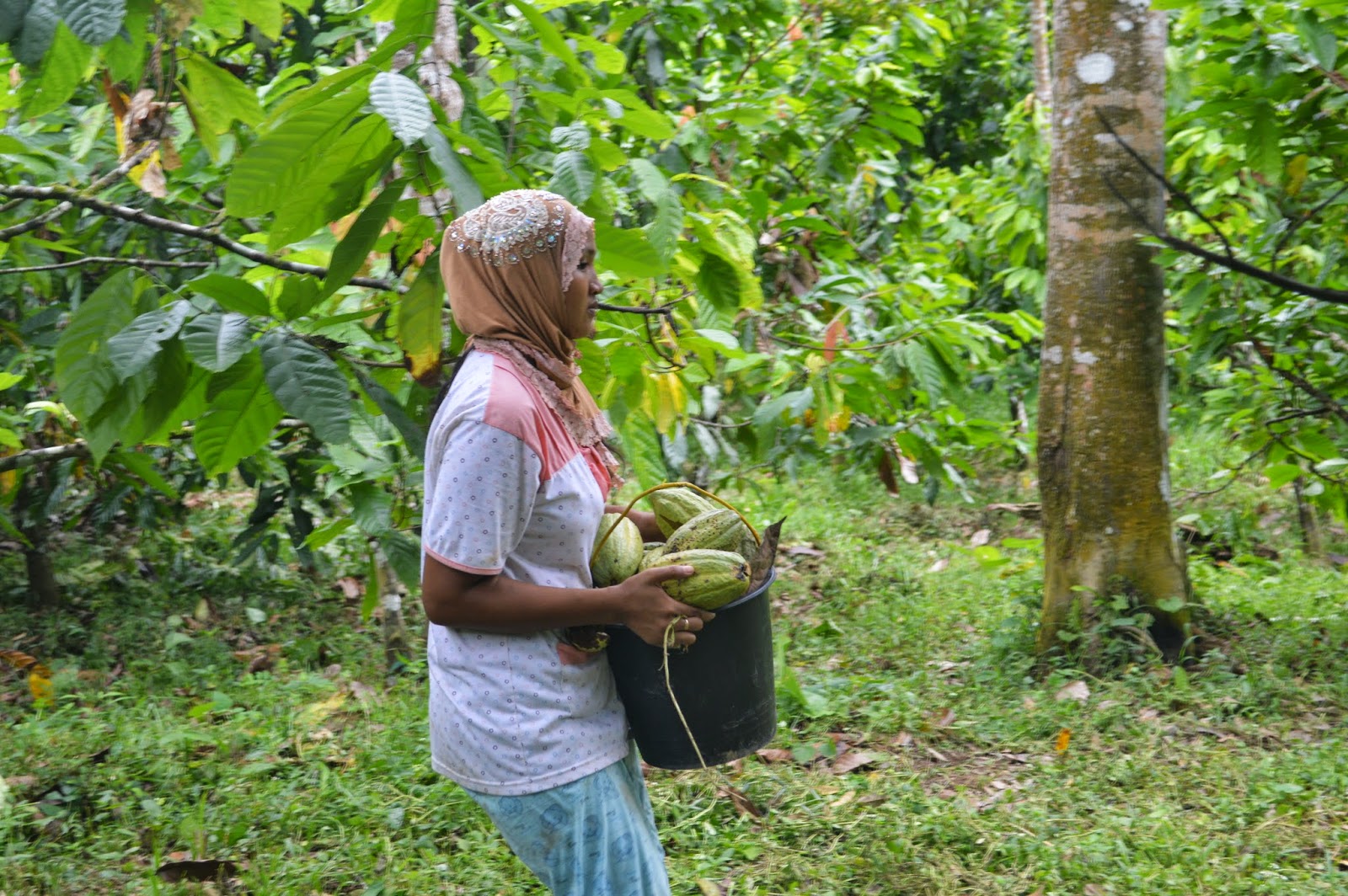
. . . and it’s a flurry of activity in Simpang Jernih and Pante Kera (two towns you don’t often see mentioned in print—and the world is the poorer for it). So let’s give the women (and their tiny helpers) a massive cheer for the incredible amount of work they have had to do this month. 


 Here’s Jamilah demonstrating good harvesting technique, and then bringing in some pods from her plantation.


Ibu Sauda is showing the interior of one of her pods. Very healthy looking!

Not only was the majority of the harvest coming in, there was lots of drying to do, PLUS the group is planting and cultivating 6,500 (count’ em) seedlings in their two nurseries. 

 Many have made it to their third week, but the immense rain during the last planting made life pretty miserable for about 1,000, so they will have to be replanted.
Leave it to Robert to save the day: the women are now using home-made “vermiculite” in the form of spent ash from their stoves to add to the medium to make it fluffier and coat the bean.  It seems to be working; nearly all of the seeds from Try #2 have sprouted.

 
Now that the farmers have 10 drying racks to share, the beans are looking better than ever—and fewer of them have to be culled.


Some farmers like to spread them out on a tarp first, to get rid of the bad beans.
Robert took these photos, and I love them all, but especially this one of a farmer’s husband looking over a big red tarp.


Here are two farmers drying and sorting their beans.


All is not rosy in Aceh Timur, however.
The women are now faced with the challenge of how to remove overgrown shade trees that cause the cocoa pods under them to rot.  The trees are too big to cut down with a machete now.  And some of them are valuable fruit trees that have to be replaced.
I am half thinking of marching myself into the forest and dragging out some illegal logging delinquent by his ear and having him make his chainsaw do some honest work for a change.

You know, I may be onto something . . .


Friday, July 4, 2014

31 cocoa farmers and growing!


As of the first of the month, Aceh Timur’s cocoa association has grown to 31 members in 2 villages.  To reach the project’s 2016 goal, only 3 more farmers need to join.  I predict that the hard work and good results these women are getting will bring many more than 3 farmers in from the two villages to join this intrepid bunch. 

 spraying to keep the flowers on the tree and keep the bugs off

The cocoa is flowering now, and so the women are doing two things; spraying the flowers, which has really helped those little guys stay on the trees longer, and building cocoa seedling nurseries to replace old and unproductive trees and to increase the number of trees per hectare (about 2.4 acres) to its optimum 800.  There are two nurseries going up in Pante Kera and one in Simpang Jernih, which had a nursery but let it go in about 2010.  I’m not going to lie and say I was happy about that.  Part of this newest phase of assistance is a lot of group discussion about whether the women want to continue this business after JMD—and all other assistanc—leaves.  If they don’t, then that’s their choice, but as they say in farming, you reap what you sow.  Anyway, the farmers in Simpang Jernih had a change of heart and are madly scrambling to construct this nursery with their own materials—JMD is not paying for anything.  We’ve promised to help them with the purchase of seedlings if they reconstruct the nursery—and they are responding like longshoremen.
putting up the poles that the netting will rest on

If you look closely you'll see that Marta is not looking too thrilled.  When asked what was wrong, she said, "This is my happy face!"  So consider this the way Simpang Jernih women smile. :)

Taking a rest in Pante Kera

Pante Kera across the river has never had any shortage of incentive.  Possibly because this little community has never received any type of assistance at all from any organization or government entity.  These days, however, the unified organization has attracted the attention of the ministry of forestry, which has dropped off several type of seeds for the farmers in both villages, and JMD has worked with them to plant some of the seeds in between the cocoa trees.

Intercropping in Simpang Jernih cocoa field

The women are loving this.  For one, the cocoa trees give a little shade to the crop seeds.  Also, there are fewer weeds.  Each plant provides nutrients to the other, especially after a harvest.  And since the farmers are spending more time in the field now—and they have a reason to, since their gardens are in the fields and not close to their houses—the monkeys have taken a hike.  So there are many more cocoa pods that make to the next stage of development.

This is such a labor-intensive business, though—and one that does not produce immediate results.  So hard for the farmers to devote so much time to something that does not give them a much-needed immediate return.  I do home this next harvest is something to crow about.

In the meantime, make way for 6,500 little seedlings in 3 nurseries on the border of the vast, fragile, and disappearing rainforest these women call their home.

There is is, right out the back door; the Leuser Ecosystem sweeps up into the hills