Spacer

Showing posts with label Indonesia cocoa farming. Show all posts

Tuesday, October 7, 2014

The cocoa harvest continues . . .


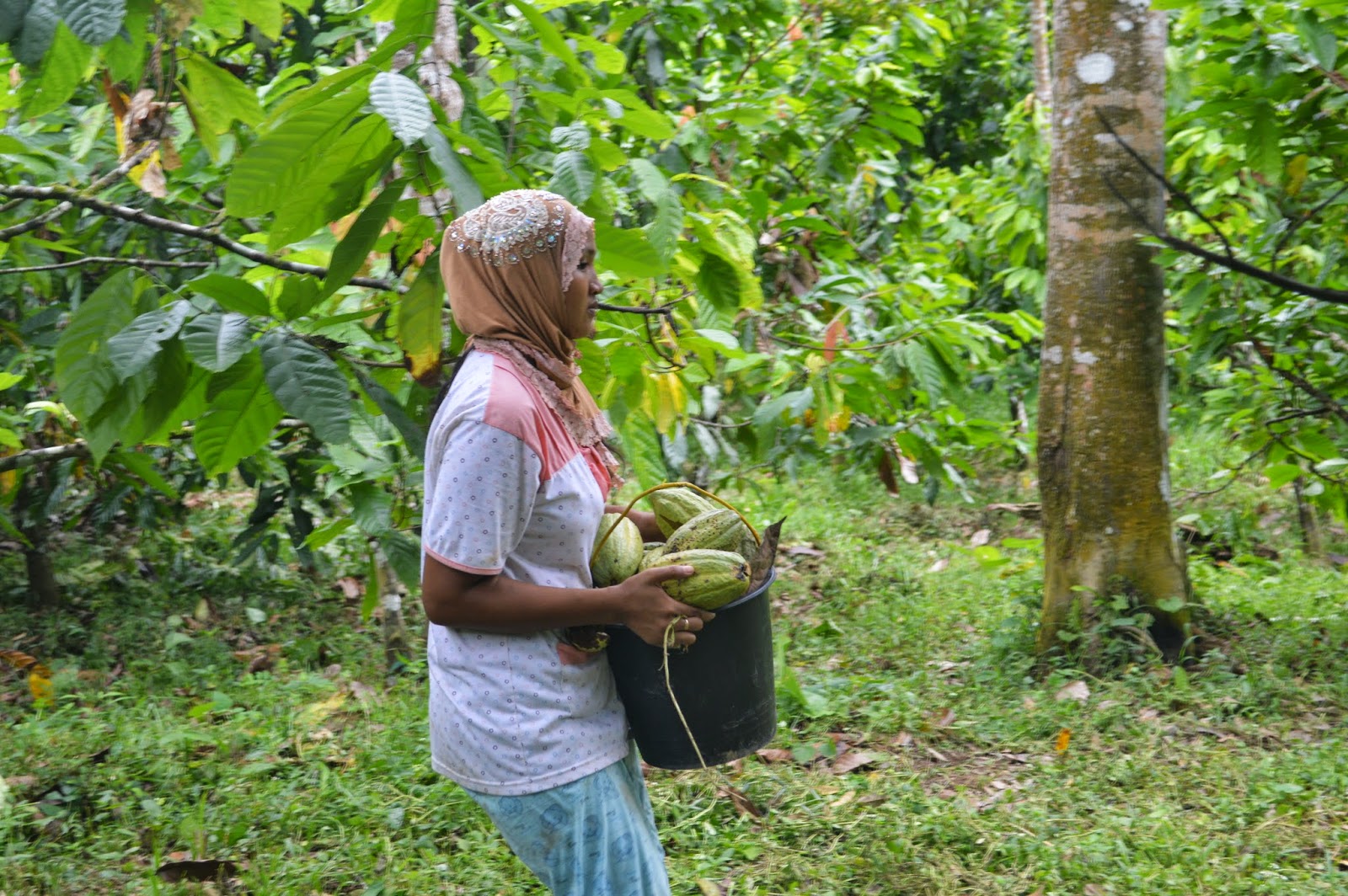
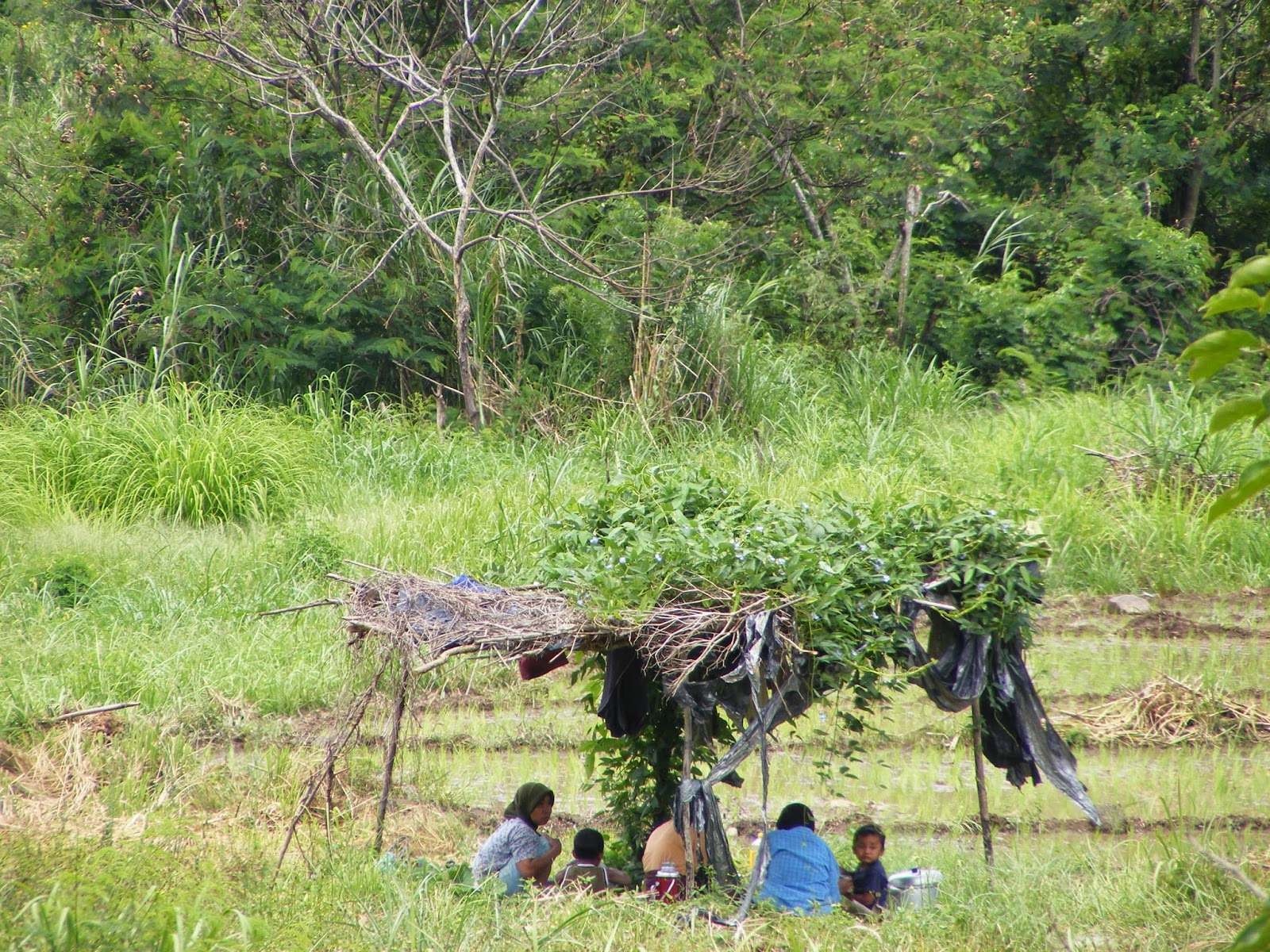
. . . and it’s a flurry of activity in Simpang Jernih and Pante Kera (two towns you don’t often see mentioned in print—and the world is the poorer for it). So let’s give the women (and their tiny helpers) a massive cheer for the incredible amount of work they have had to do this month. 


 Here’s Jamilah demonstrating good harvesting technique, and then bringing in some pods from her plantation.


Ibu Sauda is showing the interior of one of her pods. Very healthy looking!

Not only was the majority of the harvest coming in, there was lots of drying to do, PLUS the group is planting and cultivating 6,500 (count’ em) seedlings in their two nurseries. 

 Many have made it to their third week, but the immense rain during the last planting made life pretty miserable for about 1,000, so they will have to be replanted.
Leave it to Robert to save the day: the women are now using home-made “vermiculite” in the form of spent ash from their stoves to add to the medium to make it fluffier and coat the bean.  It seems to be working; nearly all of the seeds from Try #2 have sprouted.

 
Now that the farmers have 10 drying racks to share, the beans are looking better than ever—and fewer of them have to be culled.


Some farmers like to spread them out on a tarp first, to get rid of the bad beans.
Robert took these photos, and I love them all, but especially this one of a farmer’s husband looking over a big red tarp.


Here are two farmers drying and sorting their beans.


All is not rosy in Aceh Timur, however.
The women are now faced with the challenge of how to remove overgrown shade trees that cause the cocoa pods under them to rot.  The trees are too big to cut down with a machete now.  And some of them are valuable fruit trees that have to be replaced.
I am half thinking of marching myself into the forest and dragging out some illegal logging delinquent by his ear and having him make his chainsaw do some honest work for a change.

You know, I may be onto something . . .


Wednesday, August 13, 2014

Of cocoa pods, pests (of all kinds) and a look back at our coffee farmers


Everyone’s trundling back to work after the Eid holidays.  These days always fall during a really important time in the life of the cocoa pod—they’re getting big and prone to stealing by monkeys and squirrels, and also good targets for other bugs.  But the days are especially hot, and the farmers had been fasting, so it was a real chore to get out there in those fields and smack monkeys all day.    

Also, it’s time to plant more seedlings in the new nurseries.  One of the things that lots of large NGOs do not count on or plan for is how a project actually interacts with the daily routines and customs of the people who are going to have to implement it and live with it.  Sustainability is a bugger.


Speaking of which, we’re back on the sustainability trail this month, with a new project in the works to collect data and evaluate how the Direct Support to Farmers (DSF) coffee project is doing three years after the project ended.  We discovered that the lead agency, IOM, had not done any follow-up with the 1,200 coffee farmers involved in the project.  Since JMD was the agency responsible for training the farmers, and working with the 50 peer educator farmers who in turn trained 20 farmers each, we wanted to know if the tools and skills we’d given them were still being used.

The entire IM project was, of course, much larger.  God forbid the tsunami reconstruction money fund anything small and manageable.  So there was a marketing component and a value chain component and a coffee cupping competition component and a bunch of commodity-and-cooperative-related parts in which we were not involved.

So JMD decided that with its own funds it would conduct a month-long evaluation of the coffee farmers, starting with the cooperatives they belonged to, to their (paid) peer trainers, to the materials they were supplied with, to their family farms.  JMD has developed a position description for what will have to be an amazingly talented individual, to traipse around the highlands of central Aceh/Takengon ingratiating himself with the farming community and asking them if they still use drying rack to dry their beans, and how’s that new paved access path working out? 


We want to do this because, well, we want to know, but also because we are about to create a document asserting that the majority of the post-tsunami Multi-Donor Fund went to projects that had no intention of ever being sustainable, and frankly did not care to be. “Emergency” was the battle cry.  The mouse-squeak “Future” was never heard above the roar of the international NGOs as they raced for the funds.

****
In other news (and I only mention this because I am just holding my breath until October when Jokowi officially takes over and we can see the lay of the land in terms of Aceh’s environmental and social future):

As you know, wealthy sore loser Prabowo filed a suit in the Constitutional Court on July 25th saying voting irregularities cost him the election. An interesting AP photo accompanied this announcement, showing “Prabowo supporters” protesting the election: 4 women dressed to the nines, pearls and silver jewelry, sunglasses and full makeup, and only one in a sort-of headscarf.  As Aretha Franklin would say, “Who’s zooming who?”
The court began deliberations on the 6th—last Wednesday.

“We feel very, very hurt by irregular, dishonest and unjust practices that have been shown by the election organizers," Subianto told the court. [This is the same court that grew a conscience after Prabowo started threatening to use his leverage and lean on his cronies there to sway the decision his way.  Ouch!  That must have stung.]

Thursday, June 26, 2014

The cocoa's flowering again!


While the Presidential campaign continues to astonish both foreigners and Indonesians alike with its pandering, double-speak, and charge/counter-charge/counter-counter charge, most people in the provinces are quietly trying to go about the business of keeping body and soul together and taking care of their families.   The unspoken, or maybe murmured, refrain of the general population seems to be “And the choice we have is those two?  Really??”

So we will leave the candidates to their slimy machinations today, and take the 13 hour road trip and then 5-hour boat trip to Simpang Jernih subdistrict, where 24 farmers in two communities are trying to make the cocoa flowering season as productive as it can be.

The beach along the river separating Simpang Jernih village from Pante Kera village
 Town dock, Simpang Jernih :)
 
The last time the cocoa flowered was in late March/early April, when journalist Michael Bachelard visited Aceh to speak to ex-combatants about the legislative elections.  As you will remember, a cocoa flower is a beautiful thing.


But cocoa farming is not for sissies.  Even the large plantations face a host of problems, from monkeys and wild pigs constantly eating and damaging the pods, to the pollination process itself, which happens on only 2% of all cocoa flowers—if farmers are lucky!  

Midges (small flies) and bats are the only things that will pollinate the flowers and turn them into fruit.  And midges live in the rainforest so will not travel very far out of it—that is why there are so few flowers that get pollinated (only 3 out of every 1,000 flowers gets pollinated) The object is to keep the flowers on the trees for as long as possible, before they drop off.  Here is where the home-made organic fertilizer comes in, which the women spray on the trees, to give those flies and bats a fighting chance.  
Getting the ingredients together

Turning it into mush

The final product, ready to spray: a fertilizer and bad-pest pesticide all in one.

Small, "wilder" plantations like those in Simpang Jernih are becoming more popular because they encourage an "exchange" with the rainforest and its flies and bats.  So the type of farming that JMD is encouraging is actually producing more cocoa per HA than big plantations, because the big farms go far away from the forest and the flies don't travel that far.

So let’s hear it for the flies and bats, and for cocoa farmers, who Robert says are still hanging on here in their ancestral villages only because “they really love cocoa farming.”  The continual destruction of the forest for palm oil (far easier to grow, and completely destructive to the ecosystem) insures that the difficult, methodical and symbiotic practice of cocoa farming will soon be extinct in Indonesia.  One, or both, of these presidential candidates better wise up.  Or they will presiding over a vast, sterile desert.

Nothing beside remains. Round the decay
Of that colossal wreck, boundless and bare
The lone and level sands stretch far away.
--Shelley, Ozymandius