Spacer

Showing posts with label deforestation. Show all posts

Saturday, November 15, 2014

Palm Oil Giants and the Snack Food 20 appear to be crumbling under pressure . . . but is it just (diesel) smoke and mirrors?


November saw what appears to be amazing news: multinational corporations that supply and use palm oil are publically announcing new and stringent de-forestation and fair labor policies for their companies and individual plantations.  But this weary erstwhile Aceh forest-dweller wonders: will this really translate into Indonesian and Aceh-based support and implementation of these lofty pronouncements?

Some fabulous eco-warrior-type sites and blogs began reporting this month that as a result of concentrated pressure by campaigns led by Rainforest Action Network, Friends of the Earth, Forest Heroes, and a host of other NGOs who mobilized a groundswell of grassroots support, “the number of multinational companies that say they are committed to supplying and using only deforestation-free palm oil is growing fast. More than 20 global food companies have now made no-deforestation pledges and the big traders Wilmar International and Golden Agri-Resources (GAR) have both made commitments that are far stronger than the standards established by the much-maligned Roundtable on Sustainable Palm Oil (RSPO).” [which is about time--have I not been saying for years that RSPO is a circuitous crock?]

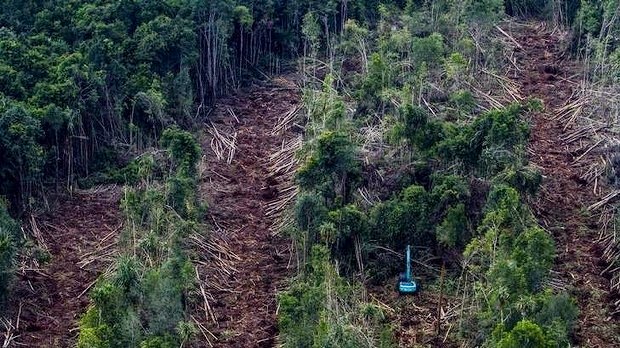
Heavy machinery makes new terraces for oil palm trees in freshly cleared forest inside the Leuser Ecosystem. Local activists say this clearing is illegal. Photo: Michael Bachelard.  See Michel’s video of  Aceh rainforest destruction at http://www.smh.com.au/world/acehs-leuser-ecosystem-pays-a-high-price-for-the-peace-dividend-20140502-zr1qh.html

 
“What a difference a season makes!” commented Forest Heroes, reporting that IOI Loders Croklaan, the world’s largest palm oil trader and recently labeled  “The Worst Company You’ve Never Heard Of” by FH, established a palm oil policy this month requiring zero-deforestation sourcing requirements. http://www.forestheroes.org/

However, like me, the gang at Forest Heroes is not so easily charmed by well-paid rhetoric. “This can’t just be a policy on paper,” said FH Director Deborah Lapidus. “Given IOI’s record, they need to move rapidly to make their supply chain transparent, address serious human rights issues, and secure participation from a credible implementation partner. While we welcome IOI’s commitment to apply the new policy to IOI Group, third party suppliers and subsidiaries, we urge IOI Group to formally adopt the zero-deforestation policy right away.”

Most of the companies leaping onto the we-promise-to-be-good-honest-we-do bandwagon have stated compliance dates for some of their holdings/farms/subsidiaries by the end of 2015. “Wilmar has committed to no development of High Carbon Stock (HCS) forests or High Conservation Value (HCV) areas, no burning, a progressive reduction of greenhouse gas emissions on existing plantations, and no development on peat, regardless of depth.  Its commitment also includes zero tolerance of child, forced and bonded labour and no exploitation of local communities. This includes respecting the rights of indigenous and local communities to give or withhold their Free, Prior and Informed Consent (FPIC) to operations on lands to which they hold legal, communal or customary rights.”

“A significant initiative was taken in New York in September. Wilmar, Cargill, GAR, and Asian Agri signed the Indonesia Palm Oil Pledge, [see The Forest Trust at http://www.tft-forests.org/news/item/?n=19862] an agreement that includes a commitment to greener palm oil development policies, more social benefits for workers, and further cooperation in establishing a mechanism to implement pledges. The signatories have also called on the Indonesian government to do more to protect forests.”  [I’ll just bet they have.]

In all of these cases, there’s language there that to my mind still keeps the door open for expansion.  And as far as monitoring all of this . . . well that has always been the issue and I cannot find any information on any of these announcements how accurate monitoring (and maintaining) of these policies is to be conducted.

Call me an old pessimist, but . . . no, just go ahead and call me one.  JMD lives right next to these plantations.  I’ll ask the gang how many armed plantation protectors disappear within the next few months—the disgruntled and jobless ex-combatants who are now paid to make sure no one gets too far in to hear the chainsaws or see the women being assaulted. I’ll bet I know the answer.

However, this may (and I stress “may”) signal a tiny new trend.  Palm oil is too lucrative for the very powerful few to go away any time soon.  The Wilmars and Cargills and Dunkin Donuts of the world can (and might) forgo a little profit in order to regain the goodwill of the pastry-eating public.  But the Indonesian government, the Aceh provincial authority, and the local billionaires who cold give a rat’s ass about their own natural resources? Getting transparent, fair and equitable policies and implementation out of them will be damn near impossible, I am sorry to say.

I wish I were wrong.  But I bet we will not see any time soon a headline that reads

“Provincial and National governments abandon plan to re-zone Aceh’s protected forests for commercial use; instead designate all remaining peat and forestland as protected and/or World Heritage Sites”

Go ahead, Forest Heroes, Rainforest Alliance, and all the lobbyists at Wilmar, Cargill and IOI—prove me wrong!!!

Tuesday, September 30, 2014

Aceh Province: Where “Conflict Palm Oil” really IS a product of conflict


Last summer, Rainforest Action Network, a tireless campaigner against palm oil and its myriad evils, launched a “Power is in Your Palm” campaign that singled out the top 20 companies who use palm oil.  RAN coined the term “conflict palm oil,” which has caught on quite well this past year, since when I was doing some side research the phrase appeared everywhere. I knew what “conflict palm oil” is in Aceh—but were there that many other places in the world where a 30-year armed insurgency has in effect protected the rainforest that now a peace accord and government complicity will destroy?


Not quite.


According to our friends at Mongabay, who always seem to get the scoop ahead of me, these 20 food giants (The “Snack Food 20”) are “failing to ensure the palm oil they source does not drive deforestation or worsen social conflict.”  http://news.mongabay.com/2013/0912-conflict-palm-oil.html#fBCQHSvVivUA7CXr.02

And FINALLY, as we suspected and reported here at length, “While many of these companies have pledged to source only palm oil certified under the Roundtable on Sustainable Palm Oil (RSPO) — the leading eco-standard — by 2015, the report argues that the RSPO doesn't do enough to protect forests or ensure "conflict-free" palm oil.”  That’s being kind—RPSO does NOTHING--as its members and policy-makers are—guess who?  the companies themselves.
 Charred tree stumps against the smoldering background in an area of recently deforested peatland near Tanjung Baru village, Pangkalan Kerinci subdistrict in Pelalawan regency, Riau province, Indonesia. The village lies beside PT. Pusaka Megah Bumi Nusantara (PMBN) – a palm oil company belonging to the Asian Agri group, a member of the Roundtable on Sustainable Palm Oil (RSPO).

Mongabay reports that “neither RAN, nor Greenpeace, which just published a report called Certifying Destruction: Why consumer companies need to go beyond the RSPO to stop forest destruction, are calling for companies to abandon the RSPO, which offers stronger environmental safeguards than the proposed Malaysian standard. [I can’t believe that’s possible.]  The groups instead are asking companies to establish policies that go beyond RSPO standards. And they are trying to rally consumers to do the same.”  http://www.greenpeace.org/international/certifying-destruction/

"The RSPO wants its members to be industry leaders in sustainability, but its current standards leave them free to destroy forests and drain peatland," said Bustar Maitar, head of Greenpeace International’s Indonesia forest campaign, in a statement. "Year after year, Indonesia’s forest fires and haze wreak havoc on the region, and the palm oil sector is a main culprit." 

Okay, so for RAN, “conflict palm oil” puts a nice, nasty, negative connotation on the product, which brings it into the public imagination like all good branding campaigns do. The “conflict” in palm oil is that this ubiquitous substance is found in roughly half the packaged products sold in US grocery stores, including favorite snack foods like ice cream, cookies, crackers, chocolate products, cereals, doughnuts and potato chips. “In fact, palm oil is likely present in some form in nearly every room of your home. It is being used as a replacement for controversial trans fats. And now Palm Oil production is one of the world’s leading causes of rainforest destruction. The clearing of rainforests and carbon-rich peatlands for new plantations is releasing globally significant carbon pollution, making Palm Oil a major driver of human induced climate change.Palm oil production is also responsible for human rights violations as corporations often forcefully remove Indigenous Peoples and rural communities from their lands. Tragically, child labor and modern day slavery still occur on plantations in both Indonesia and Malaysia.”
http://www.ran.org/join_the_palm_oil_action_team_now 

The removal of palm from 99% of all products would not harm anyone’s health, or negatively alter the product.  

However, it is one of the world’s largest commodities and makes a small number of people wildly wealthy and extremely powerful politically.

So there’s your conflict.

Now move to Aceh province, where a 30-year war that resulted in tens of thousands of deaths also decimated the fertile area on the buffer of the rainforest where generations of cocoa farmers had lived and worked.  The 2004 tsunami, which brought about the peace accord in 2005, meant two things:
--local communities could once again pick up where they left off—with assistance and training—and reclaim their plantations-turned-battlefields . . .
--the lack of armed GAM insurgents and Indonesian military brought out the jackals.  This area, which had been too dangerous to exploit previously, was now fair game to outside investors with bulldozes and government payoffs, and the only conflict these guys had was how many locals had to be thrown off a cliff or shot before the corporations were left alone to rip out the forest.

Now, that’s what I think of when I think of a conflict.
But I won’t begrudge RAN their campaign—if it works, I’m all for it.


The Snack Food 20 — Your Cookie, Indonesia’s Misfortune

Together these companies gross more than $432 billion in annual revenue. RAN believes they have the financial and brand clout to chain how palm oil is obtained, erase human rights violations and stop deforestation in Indonesian and Malaysia — if their consumers demand it.


  1. Campbell Soup Company
  2. ConAgra Foods, Inc.
  3. Dunkin’ Brands Group, Inc. (You know them as Dunkin Donuts)
  4. General Mills, Inc.
  5. Grupo Bimbo
  6. Hillshire Brands Company
  7. H.J. Heinz Company
  8. Hormel Foods Corporation
  9. Kellogg Company (think breakfast bars)
  10. Kraft Food Group, Inc.
  11. Krispy Kreme Doughnuts Corp. (more donuts)
  12. Mars Inc.
  13. Mondelez International, Inc.
  14. Nestlé S.A.
  15. Nissin Foods Holdings Co., Ltd.
  16. PepsiCo, Inc. (snack subsidiary, Frito-Lays)
  17. The Hershey Company (this makes two child labor problems for them, given their cocao sourcing issues)
  18. The J.M. Smucker Company
  19. Toyo Suisan Kaisha, Ltd.
  20. Unilever
So what’s a consumer to do? Read labels and if you see palm oil, skip buying the product. (It’s not that healthful anyway).
RAN would also like the public to send a message to these food companies to cut out the palm oil, and quit cutting down tropical forests.

Next: Global Exchange’s 2014 Most Wanted List Names HBSC as #8 . . . and so well deserved!!!

Friday, June 20, 2014

All eyes (and ears) on the forest: get the chainsaws outta there


 We came upon a little startup company the other day called Rainforest Connection. (www.rfcx.org)  They are trying to get funds to turn recycled cell phones into solar listening devices that can be hidden in the forest and can detect chainsaws (illegal logging) from up to 1k away. Their pilot project was in western Aceh.

In 2011 JMD was asked by Fauna and Flora International (www.ffi.org) to develop the direct community support component of their 5-district community forest ranger project, which trained men from the districts surrounding the forest to work as conservation officers.  The object was to have the Aceh government’s department of forestry accept these officers onto the payroll after the two-year project ended.   Well, we all know how that worked—day by day the administration grows less and less fond of spending any money for forest protection. 

But I introduced these two agencies to each other, with what I think was some success.  Rainforest Connection was delighted to find a local colleague/partner in Aceh (they plan to distribute the devices in Africa and South America as well), and FFI staff were impressed by the technology and thought that it might be quite useful in Myanmar, if cell phone coverage costs could be kept down.

Sadly, what everyone agreed on was that even with the combined efficiency of good rangers and chainsaw detection, which allows rangers to catch loggers in the act—the fear of violence and reprisal, combined with the government’s refusal to back up its conservation officers with convictions and fines/jail time, means that Aceh still can’t get out of its own way to save its forests.

ZSL Living Conservation also has a similar citizen-based technology, called “Instant Wild” (http://www.zsl.org/conservation-intiatives/conservation-technology/instant-wild) that it is pioneering in Kenya.  These are all wonderful and exciting innovations . . . . but they are all useless unless government officials stop being the lapdogs of the extraction interests that hire the majority of the illegal loggers, who thanks again to the administration have very little alternative if they want to keep their families fed.

Wednesday, June 18, 2014

I vote for the candidate who will stop deforestation in Sumatra


Our new journalist pal Michael Bachelard, who visited JMD’s projects in April, traveled back to Indonesia in May with Greenpeace to witness yet more destruction in other areas of Indonesia, this time at the hands of pulp companies pledging to stop deforestation by 2020, leaving them 6 years to completely gut Indonesia of any forest plant or animal before their “promise” kicks in.

PaperOne's environmental pledge sparks race to clear Sumatran forest
Michael Bachelard, The Age, May 30, 2014


The big cut: clearing of peatland forests on Padang Island. Photo: Greenpeace/Ulet Ifansasti

The website of PaperOne features pictures of tropical forests and a claim that the copy paper company is "protecting high conservation values". 
On the ground in Sumatra, though, the chainsaws and excavators are rushing to mow down tropical forest on delicate peat swamp to feed fibre to its mills.

As consumer pressure built on companies to improve their environmental credentials, PaperOne's maker, Indonesian company Asia Pacific Resources International Limited (APRIL), announced in January a commitment to stop logging "high conservation value" areas and peat swamp, to stop establishing plantations by the end of this year and to get all its fibre from plantations by 2020. 
It formed a partnership with environmental group WWF and announced the endorsement of the Norwegian ambassador (whose country has pledged $1 billion towards ending deforestation in Indonesia).
On the fragile environment of Padang Island, off the east coast of Sumatra, though, the deadline has prompted a new effort to clear what is left.

"APRIL's commitments mean nothing," says Zul Fahmi, Greenpeace's forest campaign leader for Indonesia. "It's just confirmation that they still intend to destroy forests until 2019."
 The company's big competitor, Asia Pulp and Paper, won plaudits last year for stopping the use of natural timber in its mills.

In January, APRIL, owned by Chinese-Indonesian businessman Sukanto Tanoto, responded with a new "sustainable forest management policy". But, under the policy, it can keep cutting forest inside its concessions until the end of the year and still use mixed tropical hardwood – taken from natural forest – until 2020. APRIL has not said where it will source that wood except from "limited-term suppliers vetted by APRIL" to ensure compliance with their policy.
Campaigners fear that, by 2020, too much of the Sumatran forest, with its endangered orangutans, tigers, rhinoceros and elephants, will be gone.

Late in May, this reporter saw from the air a dozen or more heavy machines at work on peat swamp on the low-lying island off Sumatra's fire and haze ravaged Riau region.
Canals, which are dug to drain the swamp, speared deep into forest, dividing the island into geometrical agricultural segments. Between the canals, every plant except individual ramin trees (which are protected) are cut to the ground, dragged into piles and loaded on barges.
Villagers say monkeys and wild pigs are starving and seeking food on their land, and that chemicals sprayed to kill weeds have also killed the fish in the river.
Hectares of uniform acacia plantation will replace the tropical rainforest.

Indonesian law is supposed to protect carbon-rich peat, but it does not. The peat on this island – 15 metres deep in some places and laid down over thousands of years – will drain, dry and decompose, releasing its millions of tonnes of carbon dioxide into the atmosphere. Dry peat is also susceptible to the burning that releases the toxic haze that has coated Singapore and Malaysia  in recent years. 
In nearby APRIL concessions in Riau, it is clear from the air that extensive areas have been recently burnt, though there is no suggestion the company lit the fires.

Scientists believe it is also a medium-term investment, at best. As the peat on Padang Island decays, the land subsides, meaning that, in 50 years, the island is likely to be at or under sea level and useless for cultivation.
According to APRIL's spokesman, all this work is legal and fully in accord with the company's own commitments.

"We are currently developing our last new plantation in an area of Pulau Padang licensed by the Indonesian government," the spokesman said. "Our policy mandates that the work will be completed by December . . . So if one of your questions is 'are you violating your own policy?', the answer is 'no'."
Trees and animals, though, are not the only thing at stake. Padang Island contains 13 villages, some of whose inhabitants have protested for years about the destruction of their forests and, with it, their livelihoods. 
In 2011, residents went to Jakarta to protest against the politicians who issued the concessions – 28 villagers sewed their lips shut.

Until recently, APRIL observed a moratorium on levelling the trees in parts of their concession area because of local concerns. The company spokesman said, however, that had recently ended because "the government subsequently gave the go-ahead to proceed".

This was news to Budi Wardhana, the director of sustainability at WWF, which has joined the company's stakeholder advisory committee to guide its new policy. Budi says APRIL's policy is good, but "the implementation is different from the policy as it’s written".

WWF has already drawn attention to what it sees as a breach in a high conservation value area in Borneo. It also intends to investigate the work on Padang Island, Budi said.  The company, according to him, is "still in the phase of learning by doing". 

On May 17, a group of locals went into the concession area to protest against that a disputed area of forest was being razed when there was supposed to have been more discussion. One villager, Ares Fadila, was punched in the head by police.
"The villagers asked [the concession holder] to stop their canal construction works, but the contractor said they couldn't because they have a deadline to meet," Zul said.
The deadline, obviously, is when the company will start living up to the pledge PaperOne spruiks on its green-tinged website. 
But, for the forest inside its concession on Padang Island, that will already be too late.

Michael Bachelard flew over Padang Island and other concession areas on a trip organised by Greenpeace.

Friday, May 9, 2014

Carrots, Sticks and Palm Oil: the RSPO and the myth of sustainability


Michael Bachelard’s great article (with video!) on the continued destruction of Aceh’s protected forests by palm oil barons and mining companies was followed here by a further exploration of the post-conflict “boom” in the corporate and government-sponsored assault on the Leuser ecosystem by Bobby Anderson. To round out this ghastly trinity of economic and environmental doom I’d like to reprint a 2013 article by Philip Jacobson from the Indonesian magazine Tempo, which provides and update on my posts a few months ago regarding the Roundtable on Sustainable Palm Oil (RSPO).  This entity, established with international donor funding including grants from the World Bank, has gone on to become a parody of itself.  Its extensive branding campaign has touted palm oil as “sustainable” and “green,” while it completely disregards its own regulations requiring regular monitoring for environmental protection, worker conditions, and community concerns.  I was going to say “community development,” but the administration of Aceh has now made this their new buzz phrase for unlimited deforestation and extraction, profiting government officials and the corporate heads and plantation owners. 
I am very excited that I have learned to embed entire documents into this blog so you can read the whole thing below.  I’d like to draw your attention, however, to interview with Tim Benton at the end of the article.  Dr Benton was the keynote speaker at the RSPO 2013 convention and is employed by the United Kingdom “to coordinate thinking on food security challenges over the next decades.”  He says in part: “I think the danger is thinking you can convert the whole of Malaysia or Indonesia into a plantation forest and for it to be sustainable with one or two little blips, small little remnants of forest where you put the orangutans.  You can’t ignore the large-scale problems. If you convert the whole of Indonesia into that same thing then it becomes unsustainable on a spatial scale. Then you’ve got the temporal scale: what looks good over a five-year period or a 10-year period, over a 50 or 100 period looks like shite.”