Spacer

Showing posts with label cocoa farming training. Show all posts

Wednesday, September 2, 2015

How to do a REAL cocoa improvement project


A few months ago I posted some information on an international agency that had received 6.7 million in 2008 from the post-tsunami economic development funds to do a massive cocoa improvement project in 5 districts, one of which was Aceh Timur.  Its final report to World Bank indicated that of the over 4,500 farmers the project was going to serve, at least 1,200 were in Aceh Timur. Since JMD had never heard of either the agency or its proposed project, or that there were 1,200 cocoa farmers receiving services in the district in which JMD worked, staff visited the area in 2012 and found . . . goose egg.  No one had received services, promised facilities had not been constructed, the 9 requisitioned vehicles were nowhere to be found, and $6.7 million had disappeared—poof!  like that.
Which is one of the many reasons why my blood boils when I am told that large contracts should only go to “established” international agencies because they are the only ones capable of handling the money.

Well, they handled it all right.

Anyway . . .
What JMD did find in its visit to the northwestern part of Aceh Timur was a 10-village community in the sub-district of Pante Bidari with fertile soil, great conditions, and great potential for growing cocoa, but whose farmers had received no training in how to do really good organic pest management, which makes the difference between weak, scraggly, non-productive trees and the trees we’re now seeing in Simpang Jernih.
Like Simpang Jernih sub district, the communities in Pante Bidari lie on the buffer of the rainforest, and citizens are still recovering from the effects of the 30-year protracted conflict.  So JMD asked its current project donor, the Embassy of Finland’s LCF (Local Community Funds) program, to divert some funding that was to be used for a Rainforest Alliance pre-certification visit and allocate it to a 4-month cocoa improvement project in Pante Bidari.  Unfortunately, as we found out, Aceh Timur is still lagging behind when it comes to cocoa farm certification, and so a visit at this time wouldn’t be too beneficial, since buyers are paying the same amount for uncertified cocoa as they would for certified.  An RA visit is an expensive proposition also, and so the nice people with LCF agreed to allow the transfer so that residents could begin to re-claim the livelihoods their ancestors lost during the conflict.

 Here's a map of Aceh Timur (most of it) showing Pante BIdari.  Simpang Jernih, about 40km south, is the dot right below the magnifying glass and to the right a bit--see how it's right on the river (that you have to cross by raft to get from Simpang Jernih Village to Pante Kera.) Pante Bidari is about 4 hours from  the main road  which should make for easier farm-to-market access, but JMD reports the connector road is still pretty bad.

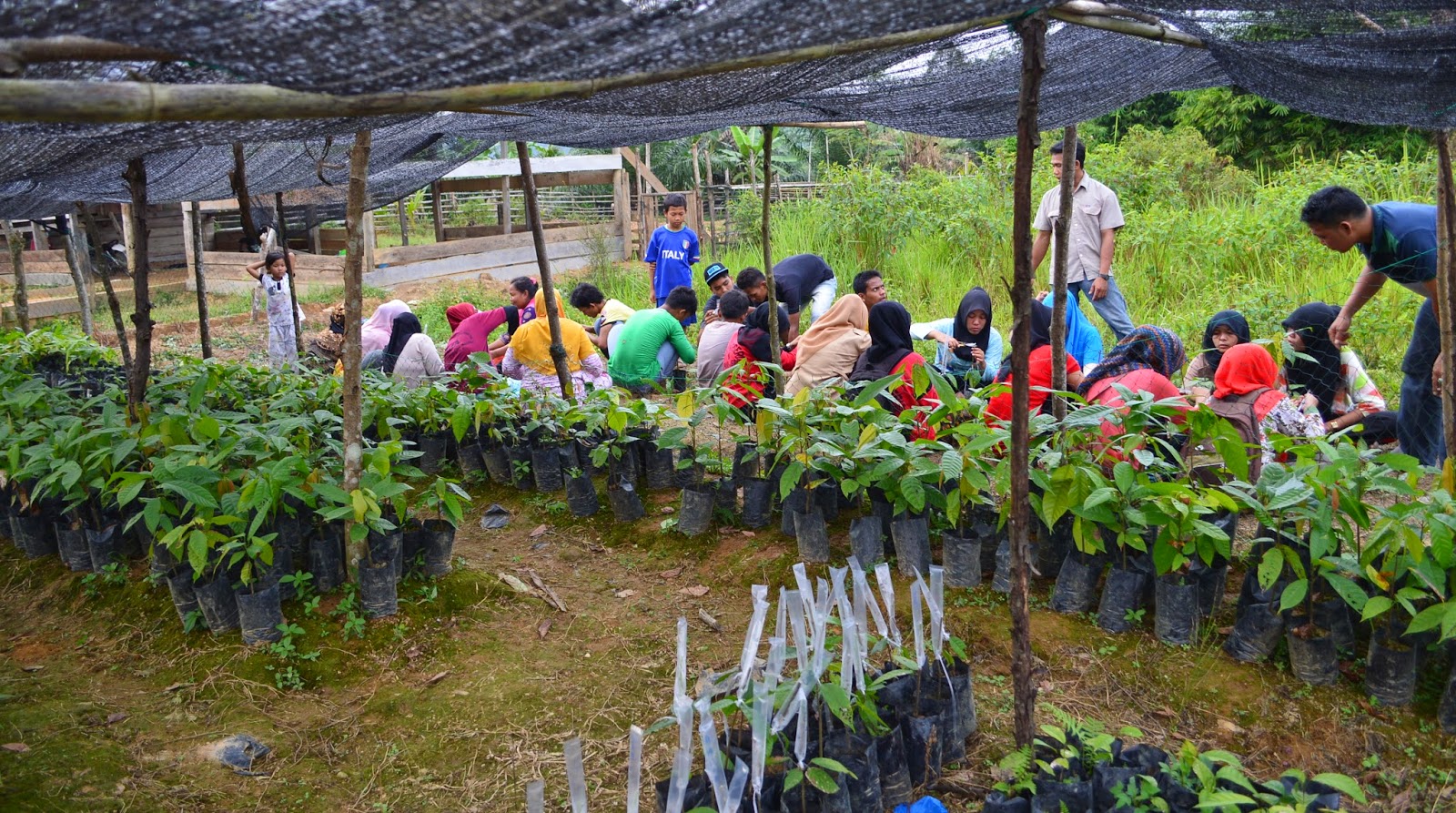
Our plan is this: JMD is contracting with our very intrepid trainer to conduct 3-day pest-control trainings in 4 separate communities.  These trainings will be similar to the training that farmers received this past summer (weeding, pruning, maintenance for healthy plants, integrated pest management) and include training in how to create liquid organic fertilizer/pest control.

We’re estimating that estimate that 20 cocoa farmers, predominantly women, will attend each training. 

So for a relatively small amount of funding JMD will be able to reach at least 80 farmers, and through one training component they will have tangible evidence that it’s possible to re-establish cocoa farming as economically viable livelihood.  In this way, Aceh Timur district will be closer to the economy of scale necessary for an organic certification process to make an economic difference in the lives of these farmers.

Junaidi and Robert will be traveling to Pante Bidari next week to meet with lots of people, including all the village chiefs (Camats) as well as representatives from the Forestry and Agriculture Department.  Plus (and this is where it gets interesting) they have submitted requests and itineraries to the Aceh Military base and local police departments because (of course!) the bad guy du jour, one Din Minimi, and his band of separatist thugs are said to be holed up somewhere in that very sub district, and gunfire has been exchanged in recent weeks.  I am extremely concerned for the staff’s safety, but I wanted to mention this because this tiny agency is going where no one else dares to, and it can’t even get funding from any international agency (besides LCF) to increase its programming or administration.  World Bank gives $6.7 million to an agency that disappears, but because JMD is local they get bupkus . . . and still they are going to go try to make a difference in the lives of the rural poor in the province where everyone else is too frightened to venture.

I’ll try to post some photos when I get them.  Go to JMD’s website.  Make a donation.  Support this agency and help these cocoa farmers.  This matters.

Tuesday, September 1, 2015

August in Simpang Jernih: the harvest season begins with great training and healthy trees


Robert’s been helping some of the farmers with some early harvests these past weeks—Aceh Timur has begun the season, which is a long one due to the variation in elevation and temperature on the farms, even though they’re quite close together.   

The rainforest has its own micro-climate and really affects when and how the cocoa ripens.  Speaking of the forest, the monkeys are really at it this year, due in part to the drought that has pushed them out of the forest to look for other food, and finding their absolute favorite (cocoa), the farmers and their families have been run ragged trying to keep them away from the trees.  But look at these babies!  This is what organic fertilization and pesticide can do to a tree’s production in just one year!


Both Pante Kera and Simpang Jernih farmers received their 6th training in August, under the Local Community Grant from the Embassy of Finland.  (Yay, Finland!)

This time, three trainers were on hand to discuss proper seedling planting, paying special attention to tree placement in relation to shade trees, and how to measure correct distances from shade trees to allow for the cocoa tree’s growth. 


 Farmers still have about 500 trees that were grown in the nursery early this year, and in the coming weeks, in addition to the harvest, they’ll be planting these new trees in the perfect spots for them to be as productive as possible.   

Add to that their grafted branches from superior varieties, and cocoa production should really soar.   

 Robert and the farmers have a harvest chart that tracks production so at the end of this harvest we’ll be able to see what percent increase they realized.  


 I think everyone’s going to be happy!


Thursday, July 30, 2015

Back from Ramadan . . . and into the cocoa fields with GPS in hand


The farmers (and Robert) had a much-needed break during the Eid holidays that ended last week, but time and cocoa wait for no man (or woman) so Robert returned to Aceh Timur, where all was once again a flurry of activity, with big healthy seedlings being delivered from the nursery into the cocoa fields.

Our goal is for every farmer to have at east 400 cocoa trees per hectare of land, and most have between ½ and 2 hectares (about 1 -5 acres) which is actually quite a lot of cocoa, once the grafted branches start producing.  One of these varieties can produce up to 40 kilos per tree per harvest!  We aren’t going to get quite that much, but the clones that the women are now using will be a big improvement.


Also this week was the introduction of a tiny new gizmo—the Garmin GPS,  which Robert will use to teach the farmers how to plot out their own farms.  This is quite useful in terms of making sure exactly where boundaries are in terms of the rainforest/protected area, as well as plotting the location of all the trees and the dates of their planting, and other useful information that aids in record-keeping.

Obviously this is not a traditional farming activity!  Most of the women keep all the information about the trees, the harvest, the amount of fertilizer/pesticide they use on each tree, etc. in their heads.  JMD has tailored its trainings to suit the education/literacy levels of the farmers, so far with good results.  But into every successful small business a little paperwork must fall, and we are hoping that the fledgling association can maintain some rather “modern” record-keeping in terms of GPS tracking, nursery inventory, and plantation mapping, because when they get bigger . . . they are going to be surprised at how useful written records can be!


Tuesday, March 10, 2015

A new crop of grafting experts emerges in Aceh Timur


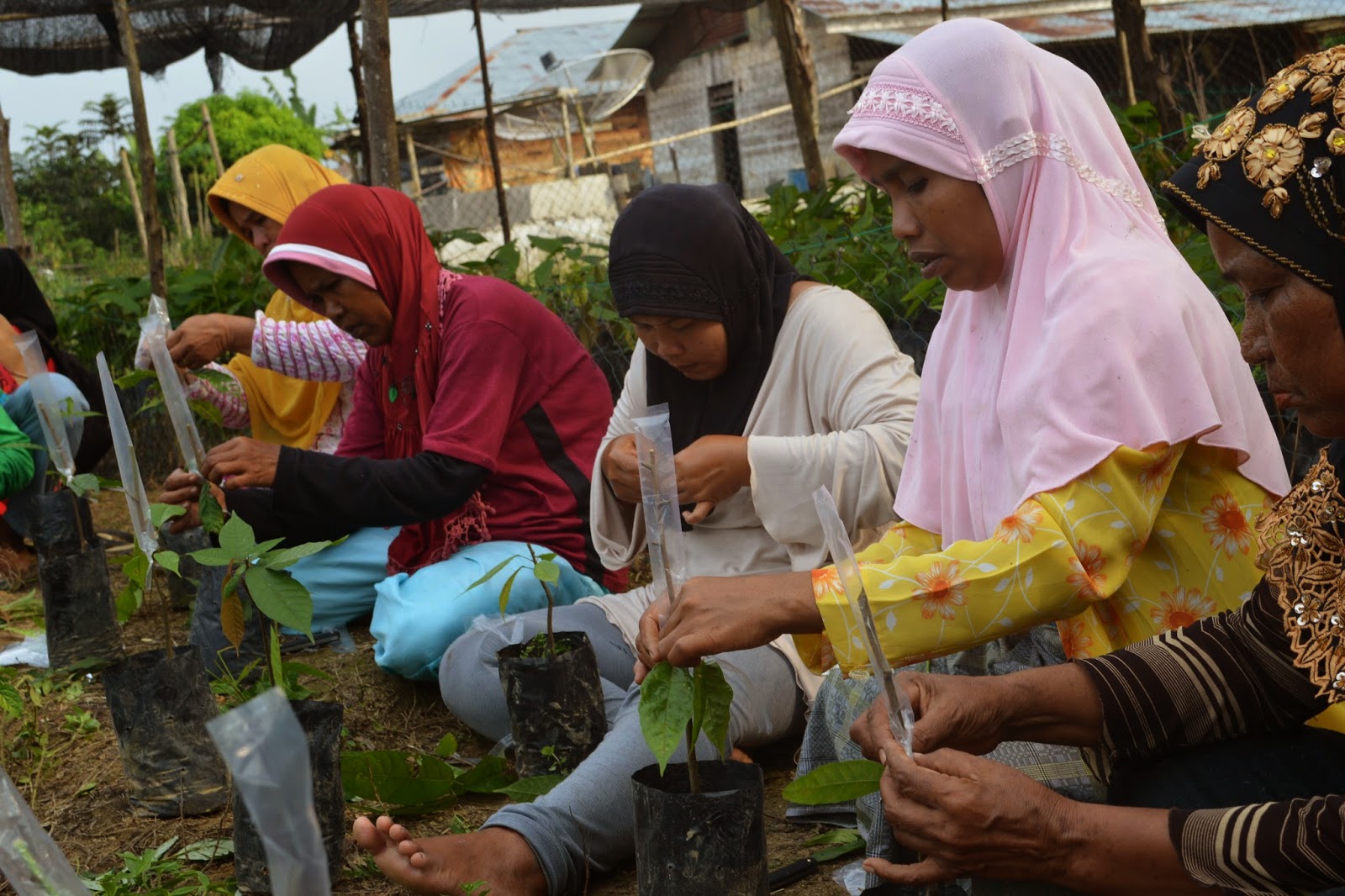
As I’ve said many times before here, grafting of any type is an art form.  And cocoa grafting is especially challenging, since the places where cocoa grows best are not necessarily greenhouse-like conditions.  But the women of Simpag Jernih, Pante Kera and Batu Sumbang proved equal to the challenge and during the week-long training grafted hundreds of buds and branches onto both nurser rootstock and mature trees in their fields.

The trainer held the training twice, in two different locations, for the convenience of the farmers, to eliminate additional boat trips between villages.

The trainings covered many aspects of a successful grafting process.  JMD has given this training before, but refreshers are always needed; this is one of the most important, and difficult skills foe a successful cocoa farmer to master.

There was a little classroom presentation, in which Robert assisted:

And a bit of field-based explanation prior to the practicum:

Then the farmers went straight to the nursery to learn the proper way to prepare the shoots for grafting, and the tree or seedling for accepting the graft


Robert also took a short video of the women practicing grafting the rootstock in the nursery, that JMD willl post to its Facebook Page (unfortunately it is too big to load onto this page; we're just learning abou t how to control the file size of videos).  Even if you don’t understand Acehnese or Bahasa you can tell they are having fun; one of the great things about this project is that it takes skills the women already possess (their ability to do very delicate and exacting work with their hands) and transfers it to an economically viable livelihood. 

Each woman has been given grafting tools and tape by the program, and did many top and bud grafts in the nursery, onto which were placed plastic baggies for added protection.


Grafts in the farmers’ plantations required training in side grafting and protection.


This is the first training that our three new farmer beneficiaries, from Batu Subang, were attending.

And it’s also the beginning of a “training of the trainer” for a farmer in Pante Kera, who’s been very successful on her own farm and will act as a peer mentor to her colleagues


Was this a great training or was this a great training? 

.

Thursday, September 4, 2014

Back to Aceh Timur and those intrepid cocoa farmers


August was a busy month in Aceh Timur.  Because of some careful perimeter patrol and the application of homemade organic fertilizer/pest control, the women have experienced a 50% reduction in diseases and bugs on the plants, and much less monkey-munching.  The fertilizer keeps the cocoa flowers on longer, meaning more pods form.


Now THOSE are nice healthy cocoa pods!

The women were also hard at work planning about 6,500 cocoa seeds for their nursery.  Seedlings are used both to graft onto old growth trees to encourage more pods to form, and to create stronger “parents” to replace dead or dying trees.


And this month JMD sponsored the fifth Finnish Embassy-funded  training: Marketing.  This is a really new concept for the women, who have traditionally been at the mercy of local collectors or, when the collectors do not arrive in time, other vendors will barter goods for cocoa beans.  Now the women have developed a system to collect the harvest in one place and contact the actual buyer, who will pay a premium price for organically grown beans, and will travel from the port city of Kuala Simpang to pick it up, now that the quantity makes it worth his while.


There are a lot of other aspects to the marketing training that were covered, but we think that this was the most important: to let the women see that they have a desirable product and that if they play their cards right and unify their harvests, they can control the game and not the other way round.  This is an enormously large step for these women, many of whom have never been part of any group before, have difficulty reading and writing, and who now are initiating contacts with cocoa production companies, keeping records, and recording sales.  

Maybe a large NGO would think that unless an agency serves thousands of people at a time, a project isn’t “cost effective.”  I think that in this small community, the success of 31 women is a pretty big deal for everyone.