Last week I was invited to Aceh, along with several other colleagues with whom I worked in 2005 in the early days of reconstruction, to a commemorative celebration honoring the 10 year anniversary of the 2004 Indian Ocean Tsunami. I am not the only one who is too disgusted to go.
I know what I will hear. I know
I will be expected to smile, and thank the current Governor for inviting me,
and look down demurely when he praises the work the NGOs did to bring the
province back from the brink of disaster and make it the vibrant, positive,
humane and safe place it is today. . . I am not going because if I have to hear
that drivel I fear I will vomit. My
colleagues agree; most are declining the invitation. It is, so sadly, all a farce.
Shortly
after this invitation I received an email from our Australian colleague Michael
Bachelard, who met and traveled with JMD this past April when covering the
legislative elections. I’d first gotten
in touch with him because of all the international journalists reporting on the
ravages and dire global consequences of palm oil’s destruction of the Aceh
rainforest, he was by far the most eloquent, thorough, and passionate. His beat isn’t just palm oil, however, and
the Sydney Morning Herald has pulled him in many directions this past year.
I knew
he was returning to Aceh this month to do a story on the 10-year anniversary of
the tsunami, which happened on Boxing Day (December 26) 2004. If you’ve been reading this blog you know
that I’ve been urging any and all media outlets to take an honest look at Aceh
and examine whether, 10 years later, the province is truly “better” than it was
before the tsunami, in terms of quality of life, equal access, and economic
prosperity for more than just the wealthy and the multi-national corporations.
Michael’s
email included an apology for not being able to spend any time in his articles
discussing palm oil, or how cocoa was “relevant,” although he was astute enough
to cover topics such as “empty housing and personal stories of the wave, misgovernance, sharia
law, environmental doom and electoral misbehavior.”
I think that Michael’s email was the final missile in a depressing
barrage I’d been receiving all week that has me convinced, sadly, that the
entitles responsible for the most horrific things on the planet these days,
are, in the final analysis, to big to fail.
Take four seemingly separate events:
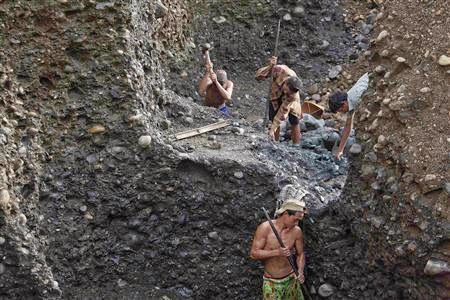
There is new focus on the continuing horror story of jade mining in Myanmar
and how corporate interests trump the rights of marginalized groups. I read this (and blogged about it a few days
ago) and was struck by the sheer enormity of the problem—not the HIV/AIDS
epidemic that will soon spread all over the country, but the seemingly
insurmountable issue that is the profitability of the Jade market in China.
Freeport, the world’s largest copper mine in Paupua, Indonesia, is
“sponsoring” an exhibit of sculpture and jewelry by the Kamoro, a tribe the
company basically wiped out in what is seen as one of the world' worst examples of environmental destruction and genocide. But a significant number of southeast Asia’s
wealthy elites are attending the show, to ooh and ahh over the “exquisitely
made” handcrafted pieces available. Those little brown people. So clever.
Much is made over the “champion” of the Komoro, Mr Kal Muller, a
transplant who’s acted not necessarily as humanitarian advocate but as PR
marketing firm for those Komoro who are still living. He’s an employee of Freeport (A US firm), after all. I’ll give him the benefit of the doubt and
imagine him as painfully torn between the irreversible damage his company has
done to this group’s culture and homeland, and his need to keep his job so that
he can at least squeeze a couple of bucks (and permission) from this lumbering
behemoth of a company in order to preserve what little space they have left in
this now-wasteland.
Searching the database of donors, including USAID, who are funding large projects in and around
Aceh, I notice that international subcontractors are being
awarded mega-sums to establish either “sustainable palm oil practices” or
assist with “palm oil biofuel projects.” Nowhere is it ever mentioned that any
significant funding is to be spent to reduce or control palm oil plantation
expansion, or to seriously look at ways to limit the environmental catastrophes
that are being caused due to plantations’ current methods of operation. This would make sense, considering President
Jokowi’s interpretation of his own energy policy to mean “capitalize on every
natural resource we have and increase production.” (Interestingly, he hasn’t
yet noticed the disparity between his “let’s stop deforestation, save the peat
bogs, and control palm oil in Aceh” rhetoric and his “economic expansion at any
cost” battle cry. Or else he doesn’t
care.)
A recent Bloomberg report on “palm oil futures” criticizing the new
Indonesian regulations for mixing palm biodiesel with other fuels wept that
this would severely hurt the price of palm oil.
Indonesia plans to increase
biodiesel blending to 20 percent in 2016, requiring more than 8 million tons of
palm oil, according to the Energy Ministry. . . . The government is committed to expanding
palm biodiesel, Hari Priyono, secretary general at Agriculture Ministry, told
reporters yesterday. . . . "If Indonesia ignores its (biodiesel) mandate
completely, the palm oil industry will face a crisis in the last half of
2015," Mistry said. http://www.bloomberg.com/news/2014-11-28/indonesia-s-toothless-mandate-for-biofuel-seen-hurting-palm.html
Most of the articles I read regarding palm oil are, in fact, from the
commodities side. Palm oil is so huge,
so important in the international market with respect to making people money,
that it is no longer pertinent to even allude to its horrific effects. That
just isn’t important to anyone except the “activists.” And what do they know anyway? Buncha spoiled little punks.
But all
these things: the invitation, the jade mining, the Komoro, Big Palm . . . they
got me thinking . . . about what good people do when their backs are against a
wall. How do concerned and committed individuals and groups respond to entities that are “too
big to fail?”
What would
the Komoro do if Kal Muller did not convince Freeport to be interested in their
culture and sponsor at least a tiny way for what’s left of them to make money?
If we are realists we will see that Freeport is not going away and the Komoro
are not coming back. So is it bad to try
and provide some type of compensation to those remaining even if it is “blood
money?”
If the
world’s large donors are staffed by people who truly understand that carbon
emissions and deforestation are vitally important, then they have to develop
plans that can address this in pragmatic ways—and that means catering to the
interests of the extraordinarily immoral entities that got us into this mess in
the first place. When fighting a war for
your freedom, said Marx, use the tools of the oppressor. They will eventually
wear him down.
I’m not so
sure.
So once
there is a mess (Freeport, palm oil, HIV jade) what is the best thing to do about
it? “Go away” is not working. Can we make it smaller? Maybe, but how much smaller is smaller
enough? Should we just be addressing the
fallout? Like in the Kachin state, what
is needed is a methadone program and street outreach for IV drug users to learn
how to clean their needles. But in a
way, that just reinforces the strength of the jade industry that sucked them
into this vortex in the first place.
All over the
world, what we are doing to the enormous creatures that have harmed us, altered
our food, poisoned our water, screwed around with our oxygen, eliminated animal
species, and displaced people with no voice, what we are doing is helping them survive. Because they have created a different
physical, social and economic reality from the one we knew before they came,
and now much of our survival depends on theirs.
So we become complicit, and talk about “sustainable” palm oil and
“area-sensitive expansion” and fair labor standards and artisanal marketing and
eco-tourism. And we sugar-coat the
mismanagement of billions of dollars that could have been the salvation of a
province but instead plunged it further into poverty and pseudo-religious
extremism.
I know it’s
a reality but I still want to vomit.
Good thing I won’t be going to Aceh.