Spacer

Tuesday, October 21, 2014

Well, he’s in.


Even the news media here in the US has high hopes for Joko Widodo (Jokowi), who took office today and will soon be bombarded with requests for favors, political handouts, easings of regulations, strengthenings of . .  .well, whatever powerful people think need to be strengthened.  The palm oil industry?  National defense?  Hopefully at the top of the list will be a commitment to a secular constitution that reaches across all the provinces, including Aceh.

It’s interesting to note that media here have said that the inaugural party will include a lot of heavy metal, which is Jokowi’s favorite.

Not too far from Punk, really—the medium that gets young adults arrested and caned in Aceh just for dressing the part.


Aceh may be a small fish in the incoming tsunami of problems waiting to crash into the new President, but it is and always has been a metaphor for Jakarta’s understanding of, and attention to, its role as a democratic unifier of cultures and customs.  So far, that understanding and attention has been way out in left field, and the environment, marginalized groups, and tolerance have suffered greatly.  This new “man of the people” takes office while the para-military death squad Pancasila Youth is still active and glorified by the administration. It’s one of many contradictions that Jokowi will have to deal with—and hopefully freedom of movement, progressive attitudes and heavy metal will win the day.


Friday, October 17, 2014

The case of the $6.7million phantom cocoa improvement project, part V


There are lots of things that JMD does well, and maybe the reason it has had such success in Aceh is because it is so small, and has such a clearly defined focus: sustainable livelihoods for people in nearly-inaccessible places.  And by inaccessible I mean too far away from the capital for large NGOs to make it worth their while, too far into territory where ex-combatants are still pretty furious about the short shrift they’ve been given by the government, and too remote for government departments to visit very often.  As soon as we had addressed emergency housing and health issues in Aceh Jaya, the epicenter of the 2004 tsunami, JMD went inland, to those areas that had been ravaged not only by the tsunami but by the conflict as well.  So the agency became quite familiar with what needed doing in the northeastern part of the province, and we let the large international agencies continue to work around the fringes of the capital and, to some extent, in the central highlands, where JMD acted as implementing partner for an Arabica coffee improvement project. 

But JMD’s forte was its intimate knowledge of districts included in AAA/Keumang’s cocoa farmer improvement proposal: Aceh Timur, Pidie, Pidie Jaya, Bener Maria, Aceh Utara.
That was one of the reasons we though we could be helpful: staff knew the local leaders, and were familiar with the current projects and local NGOs implementing them.  It would be relatively easy for us (if we secured a small amount of funding) to take AAA’s final report and conduct a program/activity monitoring evaluation. Obviously, Keumang, having left the province, and AAA, no longer working in Indonesia, could not provide this.
When I wrote (twice) to AAA, however, and called (twice) their corporate offices, I was met with silence.  Not “no thanks.”  Not “It’s really not necessary, but how kind of you.”  Nothing.  Zip.  It was as if, with that offer, the agency had decided I was too much trouble to even communicate with. Or did they just hope we would go away and not bother to evaluate what was appearing to be more and more of a mere phantom program?

So we decoded to find out what type of narrative document was on file with World Bank at the PMU (Project Management Unit).

Now, the PMU of any project strikes fear in the hearts of most implementing agencies.  It’s kind of like the IRS: they exist in some shadowy but very real way, they demand lots of paperwork, and stern-looking, overdressed people make visits when things are really going south, but you never really know to whom they contractually owe their allegiance. Whose side are they on?

In the case of the EDFF funds, the PMU were World Bank employees (as always) but they seemed to have a much larger role in program implementation than in other countries—possibly because the “capacity,” as some like to say, of the recipient agency and its subcontractors was not up to par with WB regulations.  So even large agencies like AAA and IOM and World Wildlife Fund had PMU members trotting round after them because let’s face it, no one had ever been to post-tsunami, post-conflict Aceh before, or had worked with suddenly-flung-together local NGOs or, for that matter, been given so much money in such a short span of time. And neither had any World Bank Branch.  As one World Bank manager told me last year, “No one in that office had ever dealt with that much money.  There were a lot of, well, competence problems.  But the weird thing is, most of those people who were with the PMU, and all of World Bank in Indonesia, were promoted to positions in other countries, just because the amount of money they were given to manage was so huge.  It didn’t have anything to do with how good they were at their job—it was just that they got to say, ‘Look, I handled a $50 million portfolio’ and up the ladder they went.”

Comforting, huh?

But I wanted to make sure that there really weren’t any more documents, or evaluations, or monitoring visits conducted for the AAA program on file at World Bank or whatever passed for the post-EDFF entity in Aceh.

So I asked our Aceh staff to see if they could contact someone at World Bank in Jakarta to find out where they had what I assumed was an enormous database of projects. 
What we discovered was that a) no one at the PMU in Jakarta would talk to us, and b) a staff member’s associate, who had been on the PMU during the height of the EDFF funds dispersal, told him (before he stopped talking altogether) that there was no database, there were no records, and that the PMU was basically a bunch of badly-trained wannabe bureaucrats who had all left the province, and that we’d never get anything out of World Bank, programmatic document-wise, so we should just stop looking.

We will take a nice jaw-dropping pause here, and a moment of silence to reflect upon $7billion worth of international assistance and no centralized database of programs, activities, or evaluations.  Financials, yes.  There were enough fiscal outlay justifications and balanced budgets to sink a container ship.  But not one document stating that yes we saw the health clinic building, or the 5 fruit transport trucks, or the vastly improved lifestyle of the new shrimp farmers.  I’m not saying that the implementing NGOs themselves did not have in their own offices --and subsequently online--volumes and volumes and exhaustive exit study after exit study of their projects and their fabulous effects on the province and their (get me the vapors) “lessons learned.” But the projects had no independent evaluation component, and the fiduciary (BRR/WB) did not require one, or, after a while, any project/activity narrative.

There’s certainly more to this onion than the outer layer I’ve peeled off here, so next time I will tell you about the RAN database and its spawn of other brainstorms from the (very well-funded) Good Idea Fairy, and why they all went belly-up, leaving me and JMD wondering how we could ever hope to find out if it was true that AAA/Keumang had mishandled a good portion of their allocated $6.7 million, or if indeed anyone cared.

(And by the way, if anyone reading this has some information that can demonstrate to me why I am dead wrong about this, please get in touch with me because I would dearly love to believe that all these funds were appropriately spent and  these projects that we cannot find really do exist and are doing well.  Nothing would please me more.  I'm not in this for the yellow journalism, believe me.)

Thursday, October 16, 2014

The 28-Day Palm Oil Challenge starts in early 2015: will you be ready?

There are a lot of good websites out there that document, in very grim detail, the effect that rampant and unchecked palm oil production is having on our forests.

Usually I come away from reading these feeling like I just want to hang myself.  I mean—the problem is so huge.  I am so small.  Even JMD is tiny compared to these greedy giants camped out in Aceh Timur’s back yard (and as with all environmental catastrophe, the owners and shareholders certainly never have to visit the places they are destroying—they could care less).  So sometimes I am just so discouraged I think “What can I personally do, really?  I mean, come on—really?”

Well, the folks at Say No to Palm Oil have come up with an answer.  Small, community-based, effectively broken into tiny, manageable yet satisfying doses, its 28-Day Palm Oil Challenge http://www.saynotopalmoil.com/ gets us thinking about how we as individuals can stem the tide of this needless commodity while at the same time learning about who we should be targeting when we ask companies to support us by removing it from their products.

“The 28 Day Palm Oil Challenge will be the world’s first holistic, consumer program that will help consumers to reduce their consumption of conflict-palm oil one step at a time, and ultimately live a more ethical, sustainable and healthful lifestyle.
“The program will be broken into 4 sections, “Fridge”, “Pantry”, “Bathroom” & “Laundry”, with one installment delivered per week. Each will focus on how, as a consumer, you can make small changes in relation to your consumption of products found in these specific areas of the house. You will leave the program with a wealth of knowledge, tools and resources to help you lead a more ethical and sustainable lifestyle, and be more conscious of your impact day-to-day.”

The challenge will focus on 3 main principles:
1. Swapping: finding alternative products, or finding products that  “contain genuinely CSPO (Certified Sustainable Palm Oil) or alternative ingredients to palm oil that don’t have negative environmental and social implications.” [I’m a little suspicious of that term “genuinely" and I’m going to ask them about that, but for now we’ll give it a pass.]
2. Cut Down & DIY: reducing consumption and making products at home
 3. Pressuring Companies:  via email, telephone, etc.

The 28 Day Palm Oil Challenge will begin in early 2015. If you would like to help with the development or delivery of the challenge, please write to info@saynotopalmoil.com  
Or you can go to the web page and sign up to receive notices of the challenge. But most of all, just keep reading all you can.  You'll be an activist before the end of the year, I promise!!


Saturday, October 11, 2014

The case of the $6.7 million phantom cocoa improvement project, part IV

At last I am returning to the story of Action Aid Australia’s  $6.7 million EDFF project in 2009 called Improving Competitiveness of Aceh Cocoa Value Chain to Increase Farmers Income, Create Jobs and Alleviate Poverty, and their local implementing partner, Keumang Foundation, and how through a series of investigations worthy of an Indonesian version of Inspector Clouseau we discovered that the project never existed. 

I spoke of my emails to AAA, the documents they sent me indicating that they had never completed the project or done a follow-up, and that great chunks of the project that had been paid for up front were scrapped due to the “realization” after the fact that those components were never feasible.  And these were only the parts that were available through the incomplete document—the complete one, with financials, having been sent to the World Bank (we assumed).

You must go back and read my August 28 post; it really is a corker.

So the next thing we did, simultaneously, was scour the countryside for the implementing partner (Keumang) and contact AAA’s US headquarters, since they had disappeared from Indonesia.

What JMD staff on the ground found out about Keumang was that it wasn’t ever really a sustainable livelihoods agency; rather, it was a group of data collectors and participatory rural appraisers who had just finished a project for the Australian government’s agriculture research department called “Integrated soil and crop management for rehabilitation of vegetable production in the tsunami-affected areas of Nanggroe Aceh Darussalam province, Indonesia.” http://aciar.gov.au/files/node/12948/fr2010_15__19567.pdf

Apparently they had performed adequately, and the 300+ page report states that they were in charge of basically getting the farmers together and helping the agency administer surveys. 
It may have been merely a case of biting off more than they could chew, but no RFP ever went out, so AAA probably just used them on the recommendation of this project, which was about the most lunkheaded thing I can think of to do, since what AAA was proposing was worlds away from community surveys: it was construction, fleet procurement, logistics, investment banking, training, co-op development, value chain improvement, actual agricultural knowledge . . . I have to lie down just thinking about what a bunch of geniuses this group was. 

But soon, as the final cocoa improvement report hints, AAA’s international people realized that they were being used by this sneaky faux-NGO, or else they just did not know how to control this big of a project with this incompetent a local partner, and so they justified all over the place as to why they had to spend the money the way they did.

Meanwhile, after I was taken off “hold” at AAA’s US headquarters, I was told that yes, indeed, they no longer had a presence in Indonesia, but that one of their Pacific representatives would get back to me.
Twice I called, and twice received the same message.
No one has any intention of getting back to me.

The representative who had returned my emails in 2013 (who had forwarded me the “final” 2010 report) had asked that we not use any of this information publically without contacting them.  Believe me, I tried.

What I wrote and asked her was what she thought of JMD performing the final program evaluation that AAA could not do because of the disappearance/demise of Keumang. World Bank blacklisted/suspended them in October 2013, at which point we fund out that they were NOT a local agency but ANOTHER international NGO (from Sri Lanka) posing as Acehnese.  Nice work!). http://www.treasury.gov.lk/notices/default-suspended-lis.html

It was clear at this point that AAA had washed its hands of Aceh and cocoa farming assistance, that no one was going to return any of that $6.7 million that was unspent, and that the only positive thing to do was to perform a post-project evaluation of the whole thing, which we were certain World Bank would love, and which the Provincial government would thank us for.  After all, weren’t bureaucracies always mad for those “lessons learned” documents that showed how to yank victory from the jaws of defeat?

Besides, by conducting this evaluation, JMD could do two important things: 1) learn a lot about the area in which it wanted to expand in terms of farmer assistance, and 2) network with communities that had been severely burned by this project, in order to re-establish their faith in civil society and non-profit assistance.  So we asked AAA if it would mind if we looked for additional funding to conduct this evaluation based on the report document we had.

I know you think you know what comes next, but you will be very surprised to learn just how convoluted things get, especially when this project that never existed refused to die even in the minds and on the books of Aceh government officials who still believe that it exists, much like the tooth fairy or Santa.   

More to come!

Wednesday, October 8, 2014

When piety is not the motive . . . what is?


On September 27, 2014, the Aceh provincial parliament approved the Principles of the Islamic Bylaw and the Islamic criminal code (Qanun Jinayah), which create new discriminatory offenses that do not exist in the Indonesian national criminal code (Hukum Pidana). The bylaws extend Sharia, or Islamic law, to non-Muslims, which criminalize consensual same-sex sexual acts as well as all zina (sexual relations outside of marriage). The criminal code permits as punishment up to 100 lashes and up to 100 months in prison for consensual same-sex sex acts, while zina violations carry a penalty of 100 lashes. http://www.acehmail.com/2014/10/minorities-feel-threatened-with-indonesias-aceh-province-implementing-sharia/

I was searching for articles commenting on whether Joko Widodo, who assumes the presidency on October 20, is expected to do anything to rein in the Sharia law hysteria that now engulfs Aceh—and seems to be popular with no one except “the parliament,” whose members are rarely listed anywhere (Rami Sulaiman and Partai Aceh Spokesman Muhammas Harun being the exceptions). Interviews with Aceh citizens indicate that this “crackdown” does nothing but ruin business, restrict freedom of movement, and is a general pain in the ass to normal folks who just want to get on with some sort of semblance of normal daily life.

At the same time (September 28), the national parliament (controlled by the party of everyone’s favorite war criminal Prabowo Subiato and other supporting parties) passed a bill scrapping direct elections for provincial governorships, regency heads and city mayors.  Now, leaders will be chosen by “regional councils.”  This is certainly an anti-Jokowi measure, and aims to re-centralize the government, but I wonder if a) Aceh has to play along, being “autonomous” and all, and b) would a gubernatorial appointment be any different than current guv Zaini Abdullah, a big proponent of the pervert police—and why wouldn’t he be?  Prabowo’s Gerindra party made his life very easy both during and before the campaign.  They whipped up caliphate fervor all over the province, tapping into the desperation of thousands of ex-GAM combatants who hadn’t received a dime in promised compensation after the 2005 peace accord, and who watched GAM leaders assume positions of power and leave them in the dust.   “Jakarta has done you wrong,” was the message to the disaffected (read: nearly everyone) in Aceh.  “They don’t care about you, they’ll never help you, they don’t even want you to be a Muslim anymore!  Well they can’t take that away from you—down with Jakarta, up with Prabowo, and if you elect me I’ll let you stone and behead whoever you want.”
No one had ever really thought about stoning and beheading before, but now that he mentioned it, they really were good Muslims, and wanted to insulate themselves from a now-perceived “threat” in too-secular Jakarta, so the pervert police was born. And let the subjugation begin!
Prabowo and his greedy bunch really are very, very clever.
Add a substantial war chest, and poor little Aceh seems doomed.

So what’s Jokowi going to do about it?

Not much, if the Sept 22 article in the Nation, (“Jokowi’s Way”) mentioning Aceh only once, is any indication. Remember, he’s the guy who’s said he’s “pro economic expansion” and wants to increase palm oil production by 30%. “He is now backed by some of the most well-known oligarchs in the land, whose political parties are more like obliging banks . . . “ http://www.thenation.com/article/181466/jokowis-way 

Plus, Prabowo is not finished with Jokowi by a long shot.  See the Economist’s October 4 article, The Empire Strikes Back http://www.economist.com/news/asia/21621874-old-guard-out-obstruct-next-presidents-ambitious-plans-reforms-empire-strikes

The Sharia police have now extended their tentacles into rural Aceh, where you didn’t use to have to worry about hiring a driver who was not a husband or brother to take you somewhere, or receive agriculture training from a man who wasn’t a relative. 

"This bylaw has been highly anticipated by the people of Aceh, who have long wanted to see complete Islamic law on the veranda of Mecca," [Rami Sulaiman] said.” http://www.bangkokpost.com/lite/breakingnews/434576/aceh-approves-caning-for-gay-sex

In a pig’s eye they do.

You think the farmers in the Aceh Timur rainforest have time to worry about whether the boatman who takes them across the river to their cocoa farms is a relative?
You think tiny assistance providers like JMD are going to walk away from the livelihoods of 31 women and 500 family members?
I, however, will not be able to visit these programs.  I will not be able to be driven by the Director of the agency to see the projects that I have helped develop.  I’d laugh if it weren’t so pathetic and transparent.

“Ramli Sulaiman, chairman of an Aceh parliamentary commission that drafted the law, said proving extramarital and gay sex would be difficult.
‘There must be clear evidence and four witnesses who saw the act themselves,’ he said.
‘We can't just accuse people of having extramarital or homosexual sex.’"

And yet as far as I know, the 8 men who recently raped a woman as “punishment” for what they reported (but was never confirmed) as extramarital sex were never prosecuted, AND the raped woman was caned.

That possee of perverts lurking behind lampposts and popping out from behind padangs to arrest women with nail polish having coffee after sunset—are they just hoping for a quick feel before the trip to the police station?
Show me a practitioner of this horrid mangling of true faith and I’ll show you a sexually repressed loser with very few brain cells and an inability to think for himself.

Islam shmislam.  It’s sexual predation dressed up as holy order.  Shame on the lot of ‘em. 

This is, according to the Nation article,  “the result of what happens when you join Islamic modernism with dire economic prospects in a political system in which government elites are all too happy to exacerbate identity-based violence if it means avoiding discussions about their failure to do more for the country. Their sense of opportunism runs deep. Many of the sharia-type laws on the books in Indonesia have been introduced and passed by the secularist heirs of the Suharto government, eager to curry favor with radical Muslims and get on with business.”

So with both the provincial sharia bill and the national de-centralization bill, the national government, under the populist president, is going to be sanctioning sex-obsessed witch hunts in a country whose constitution forbids that Sharia law ever supersede or contradict the Constitution.

As Al Pacio would say, “I got nothin’.”

Tuesday, October 7, 2014

The cocoa harvest continues . . .


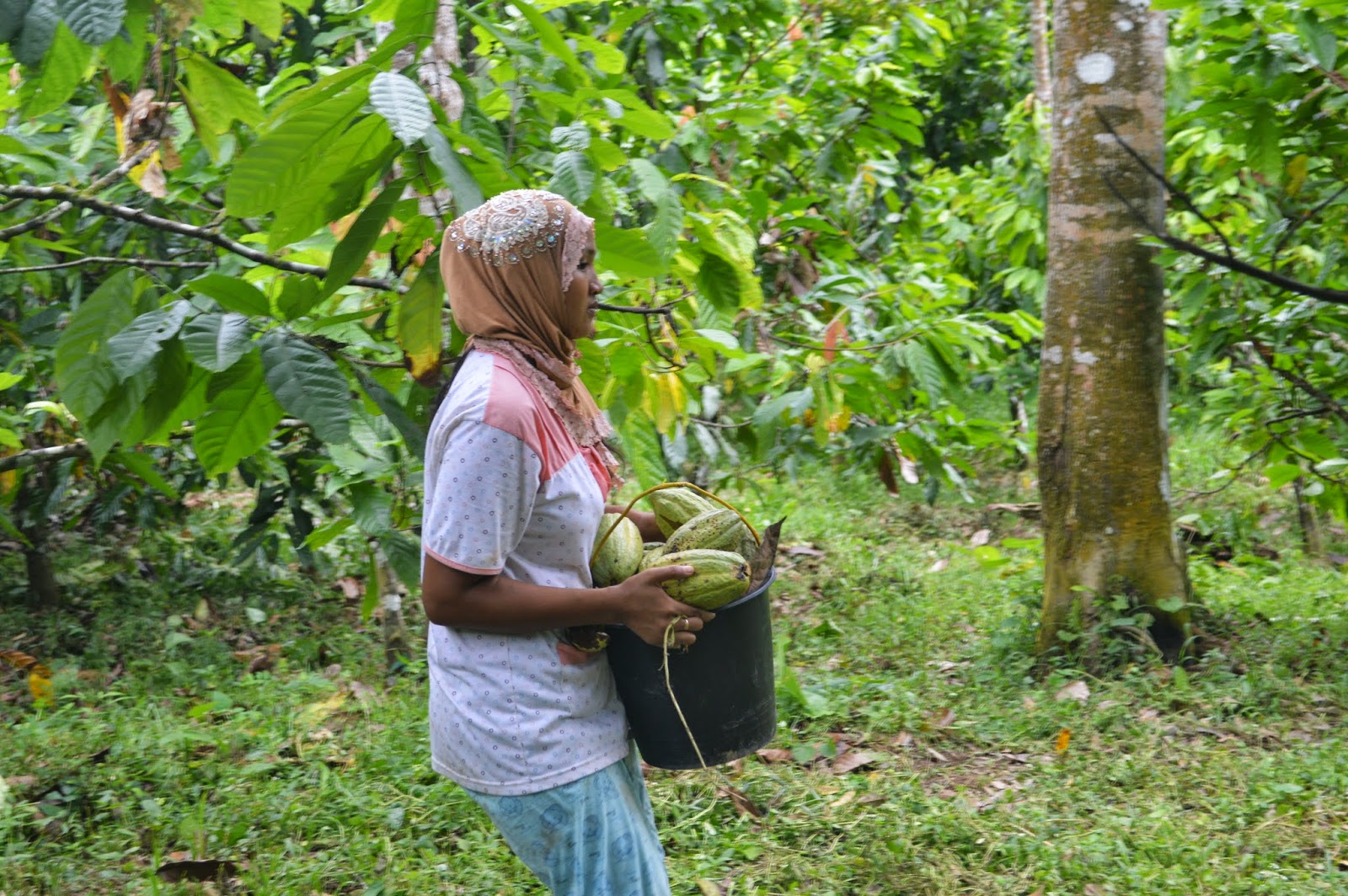
. . . and it’s a flurry of activity in Simpang Jernih and Pante Kera (two towns you don’t often see mentioned in print—and the world is the poorer for it). So let’s give the women (and their tiny helpers) a massive cheer for the incredible amount of work they have had to do this month. 


 Here’s Jamilah demonstrating good harvesting technique, and then bringing in some pods from her plantation.


Ibu Sauda is showing the interior of one of her pods. Very healthy looking!

Not only was the majority of the harvest coming in, there was lots of drying to do, PLUS the group is planting and cultivating 6,500 (count’ em) seedlings in their two nurseries. 

 Many have made it to their third week, but the immense rain during the last planting made life pretty miserable for about 1,000, so they will have to be replanted.
Leave it to Robert to save the day: the women are now using home-made “vermiculite” in the form of spent ash from their stoves to add to the medium to make it fluffier and coat the bean.  It seems to be working; nearly all of the seeds from Try #2 have sprouted.

 
Now that the farmers have 10 drying racks to share, the beans are looking better than ever—and fewer of them have to be culled.


Some farmers like to spread them out on a tarp first, to get rid of the bad beans.
Robert took these photos, and I love them all, but especially this one of a farmer’s husband looking over a big red tarp.


Here are two farmers drying and sorting their beans.


All is not rosy in Aceh Timur, however.
The women are now faced with the challenge of how to remove overgrown shade trees that cause the cocoa pods under them to rot.  The trees are too big to cut down with a machete now.  And some of them are valuable fruit trees that have to be replaced.
I am half thinking of marching myself into the forest and dragging out some illegal logging delinquent by his ear and having him make his chainsaw do some honest work for a change.

You know, I may be onto something . . .


Friday, October 3, 2014

Different face, same disregard for the rainforest


There was a bit of a kerfluffle this week in Jakarta, with news outlets commenting on the government’s elimination of “the controversial foreign ownership clause” in the new plantations bill.  Regardless of who controls palm oil plantations—foreign corporations or “smallholders” (and in this context the term is more than laughable)—Indonesia has recently “set an ambitious goal of raising its palm oil output by a third to 40 million tonnes by 2020.” (Reuters 10/1/14)  So where does the administration think that output is going to come from?  Doubtless new prez Jokowi is not only going to be referred to as being physically similar to our President, he can now be compared to Obama in terms of turning his back on all the environmental protection campaign promises he made prior to taking office.  
 
Tuesday’s Jakarta Post reported research analyst Hoe Lee Leng as saying “Widodo is known to be pro-business and pro-agriculture, so it [the foreign ownership clause] doesn’t sound like something he would implement once he comes into power.” Nice going. 

And I thought we had a chance with this guy.

If you ask me, the reason why this didn’t cause more of a ripple on the ground is that the bed is so crammed full of cross-national sleazeballs it doesn’t really matter in whose name the “ownership” of these palm oil disasters is listed. Nobody who’s currently making millions off the backs of the local communities and at the expense of the extinction of tigers, elephants, and orangutans is going to suffer.

Does Jokowi even realize this?  Does he have any environmental advisors?  Or he is just hoping we all look the other way and keep buying Hershey’s candy bars and Dunkin Donuts?